Beyond the Three Passes
National Blueprints, World Cup 2026: England

From day one we were very clear that we are trying to select and build the best possible team, which is not necessarily to select and collect the 26 most talented players. Teams win championships... We have specialists for different scenarios; when we're leading or chasing a result. We have set-piece specialists for that and we want to be a strong penalty team, we have specialists for that.
- Thomas Tuchel, 2026
Identity & Historical Context
“The English codified football just as the French did Bordeaux. The French don’t ask the English to come over to make Bordeaux.”
- Arsène Wenger, My Life in Red and White, 2020
Since the formation of the Football Association and the formalisation of the modern game, English football has often understood itself through pragmatism. From the kick-and-rush instincts of the late nineteenth century, to Herbert Chapman’s W-M, to Alf Ramsey’s Wingless Wonders in 1966, England’s footballing identity has rarely been detached from function, physicality, and structural simplicity.
That pragmatism produced England’s greatest moment.
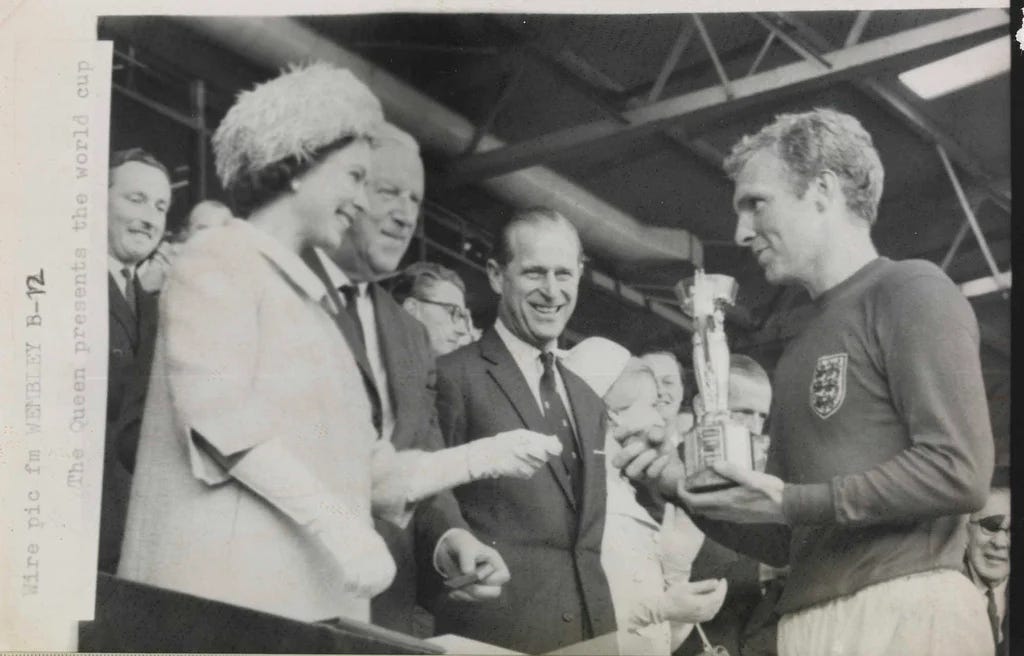
The 1966 World Cup remains the nation’s only major international honour, built not through romantic excess, but through Ramsey’s willingness to reject convention and construct a side around balance. The Wingless Wonders were not England abandoning their identity. They were England refining it.
Yet in the decades that followed, English football often became trapped by its own mythology.
The direct game, shaped heavily by Charles Reep, Charles Hughes, and the obsession with efficiency through limited passing sequences, created a tactical culture that frequently confused simplicity with clarity. The “three passes” idea became more than a statistical claim. It became a worldview. It suggested that football could be reduced to territory, second balls, physical duels, and rapid delivery into dangerous zones.
At club level, English football was never quite that simple.
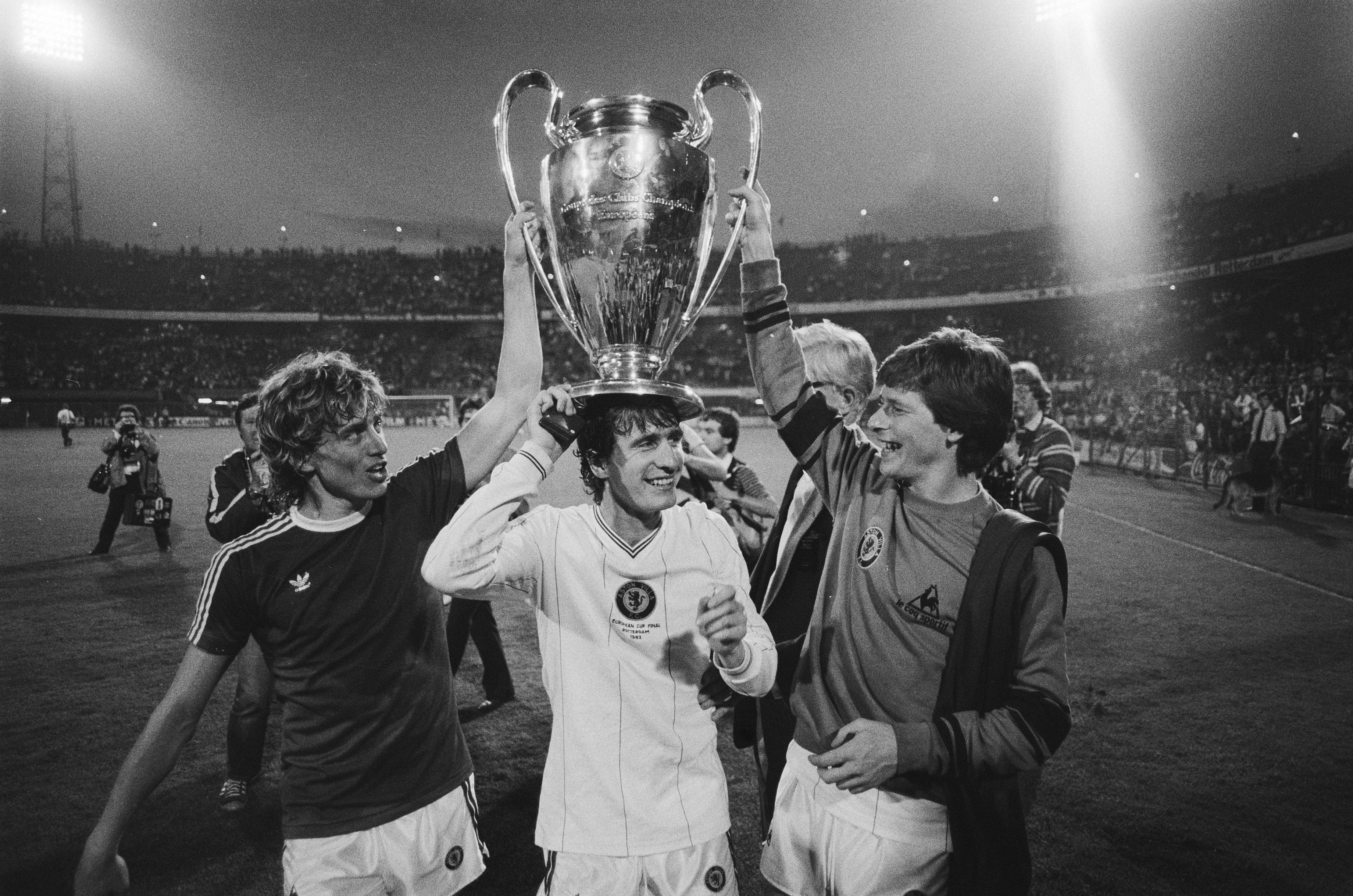
The late 1970s and early 1980s brought European success through sides that were often more sophisticated than the caricature of English football suggests. Their football could contain passing, patience, European intelligence, and managerial idealism, but the wider culture still carried a pragmatic outlook: win territory, manage personalities, survive pressure, and impose competitive will. Later, the Premier League era imported tactical ideas from across the continent. Yet internationally, England often remained caught between old instincts and new ambitions.
That tension followed England internationally.
The national team often remained caught between old instincts and new ambitions. The Golden Generation of the 2000s possessed elite individual talent, but lacked the collective structure to turn names into a coherent team. England did not suffer because they had too many stars. They suffered because the stars were never placed inside a system convincing enough to protect them from the country’s own contradictions.
That is why the modern England question is not simply about talent.
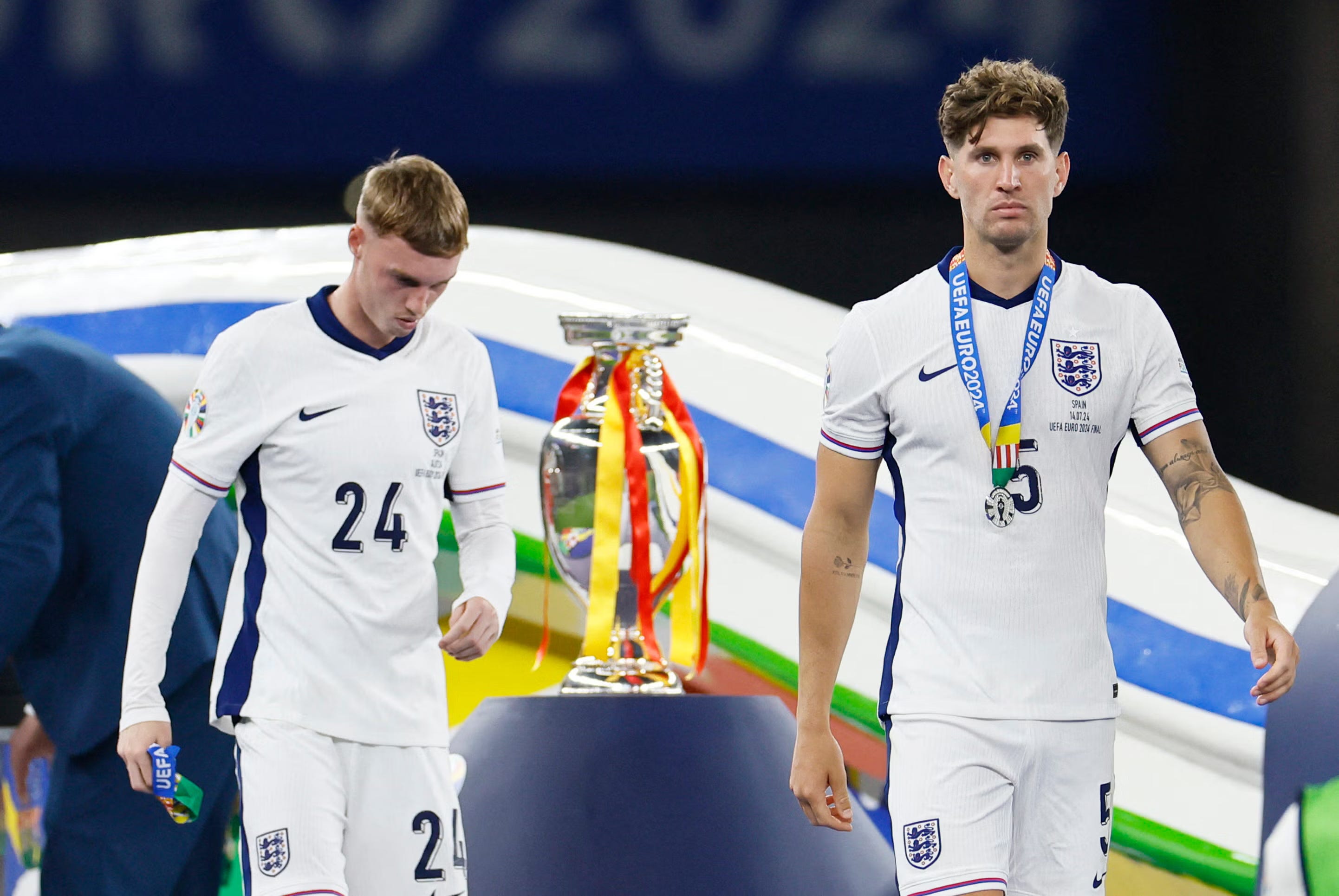
England have already moved beyond the old ceiling in tournament terms, reaching a World Cup semi-final in 2018, the Euro 2020 final, a World Cup quarter-final in 2022, and another European Championship final in 2024.
The challenge now is whether Thomas Tuchel can build the missing bridge.
If England’s past was defined by the belief that the game could be simplified into three passes, this generation must prove it can move beyond that old absolutism. Not by rejecting English football’s physical edge, directness, or competitive bite, but by placing those traits inside a more coherent modern structure.
England do not need to become Spain. They do not need to become France. They need to become the best version of themselves.
A team that can still run, duel, cross, press, and punish transitions, but without reducing football to one method of attack.
A team beyond the three passes.
The Modern Problem
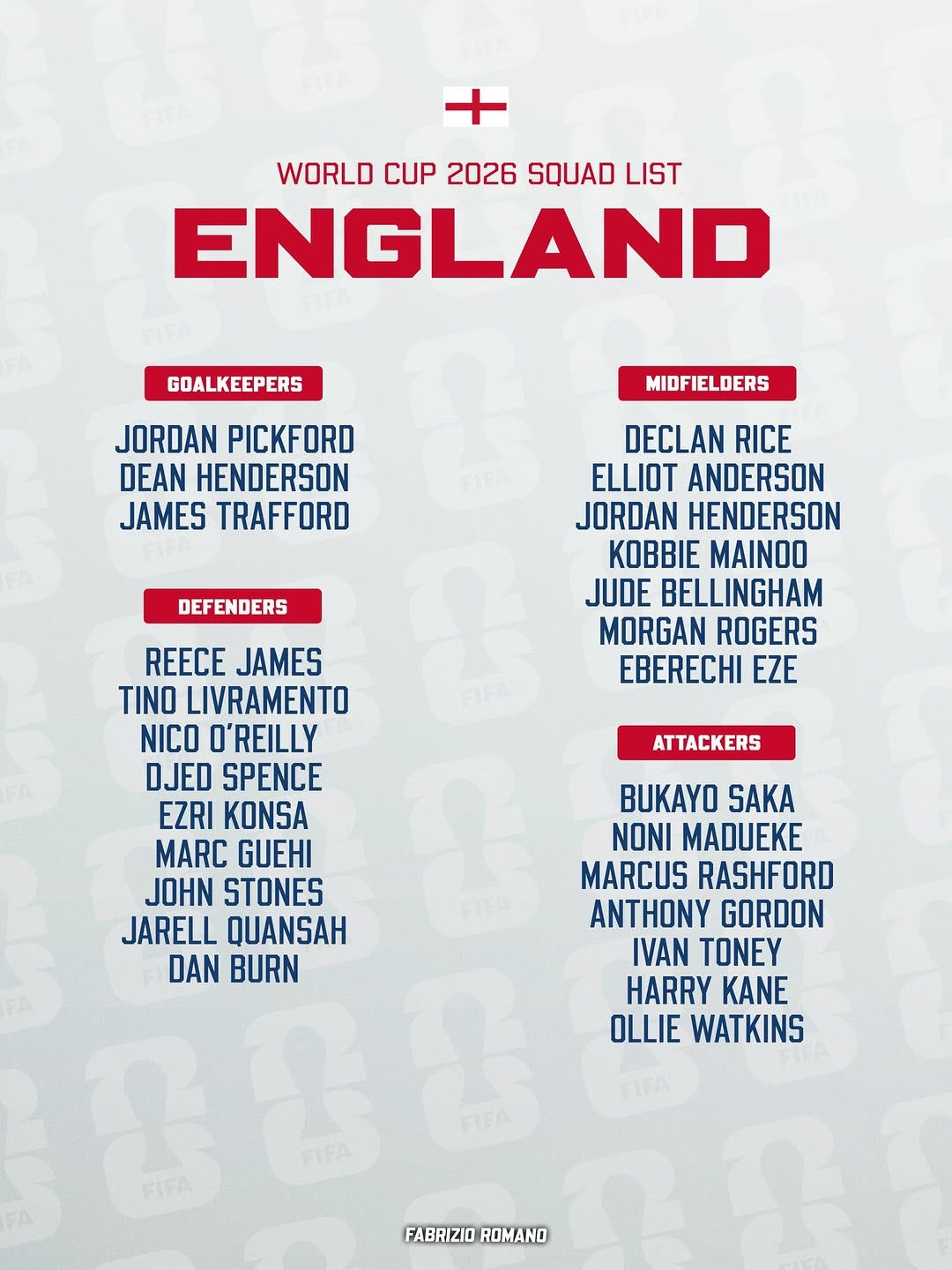
As England prepare for the 2026 World Cup, Thomas Tuchel inherits a squad filled with athletic range, tactical versatility, and tournament experience. Yet the selection also reveals several structural questions beneath the surface.
This is not an England side short on talent. It is an England side searching for the correct relationships between that talent.
The absences of profiles such as Phil Foden, Cole Palmer, and Trent Alexander-Arnold remove some of England’s most natural final-third creators and deeper playmaking outlets. In their place, the squad leans more heavily toward runners, duel-winners, wide threats, transitional forwards, and adaptable defenders. That does not make England weaker by default, but it does shift the burden of creativity away from individual improvisation and toward collective structure.
The central question is therefore not whether England have enough quality.
The question becomes whether Tuchel can build a system that allows England to remain physically dominant without falling back into old habits of sterile possession, disconnected attacking phases, or overly simplistic directness.
England’s modern problem can be understood through three connected tensions.
The Declan Rice Duality
Declan Rice is England’s most important midfield stabiliser, but also one of their most dangerous midfield carriers.
That is the contradiction.
As a lone anchor, Rice gives England security. He protects counter-attacking lanes, covers wide defensive spaces, and allows the attacking players ahead of him to operate with greater freedom. In that role, he becomes the player who keeps the structure from collapsing underneath the ball.
But that same role can also hide one of his greatest strengths.
Rice is not merely a defensive midfielder. His ball-carrying, pressing range, recovery speed, and ability to surge through midfield make him valuable as an aggressive number eight as well. When chained too deeply, England gain stability but lose some of his forward-driving power. When released higher, England gain athletic momentum but risk weakening the base of the team.
This is not simply a question of whether Rice should play as a six or an eight.
It is a question of how England distribute responsibility around him. If John Stones, Reece James, or another profile can step inside to help stabilise the base, Rice’s engine becomes a weapon rather than an insurance policy. If not, England may be forced to keep their most complete midfielder in a more conservative role than his full profile demands.
The Missing Final-Third Specialist
England’s squad also presents a different creative problem.
Without players such as Phil Foden, Cole Palmer, or Trent Alexander-Arnold in this selection, England lose a specific type of final-third imagination. Not necessarily creativity in general, but the kind of flair-heavy, rhythm-bending invention that can unlock compact blocks through disguise, pause, and manipulation.
That places greater responsibility on the remaining attacking structure.
Jude Bellingham can create through gravity, ball-carrying, box crashing, and emotional force, but he is not a pure tempo manipulator. Bukayo Saka offers elite right-sided stability, timing, and decision-making, but he is most devastating when the system gives him repeated isolation opportunities. Kane remains England’s deepest creative reference point, capable of dropping between the lines and turning the attack into a web of third-man runs.
The danger is that England become creative through moments rather than rhythm.
Against open opponents, that may not matter. Kane can drop, Bellingham can surge, Saka can isolate, Rashford can attack space, and Rice can carry through broken midfield lines. But against low blocks, the absence of natural final-third artists may become more visible. England can still create, but the method must come from coordinated movement rather than individual improvisation alone.
This is where the challenge becomes subtle.
England do not need to become a possession team for possession’s sake. But they do need enough attacking structure to avoid becoming dependent on crosses, transitions, set pieces, and Kane solving the final-third equation by himself.

The Adaptability Spectrum
England’s third problem is not simply whether they can attack space. It is whether they can recognise when space exists, when it must be created, and when chasing it too aggressively becomes a trap.
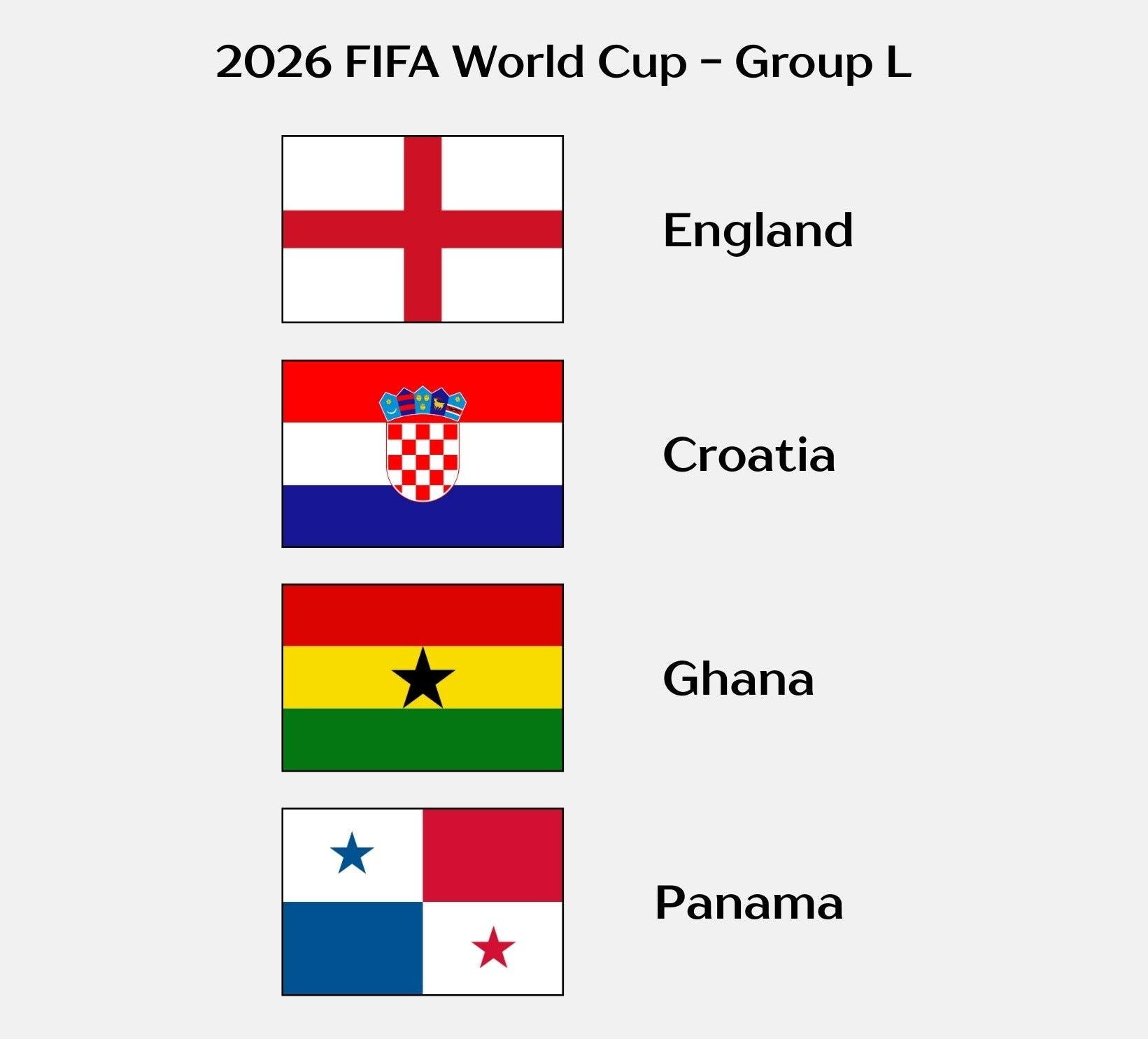
That distinction matters because their group presents three different tactical puzzles.
Against Croatia, England may face a side historically comfortable controlling possession, slowing tempo, and turning matches into midfield chess. In that context, England’s transition threat becomes valuable, but only if it is paired with immediate counterpressure. The objective cannot simply be to run forward quickly. It must be to win the ball back before Croatia can compress the pitch, reset their midfield structure, and turn England’s athletic advantage into a positional waiting game.
Against Ghana, the equation changes.
If Ghana invite a more transitional match, England must avoid giving away the same spaces they hope to attack themselves. In that scenario, the challenge becomes control rather than release. England would need to manage possession with greater patience, ensuring that their own attacks do not leave the midfield and backline stretched across too large a distance. A game of constant transitions may suit England’s physical profile, but it also risks turning the match into a coin flip.
Panama represent the opposite problem.
Against a deeper defensive block, England’s greatest risk is sterile possession. They may dominate territory, recycle the ball, and accumulate pressure without actually disturbing the opponent’s defensive structure. This is where the absence of certain final-third specialists becomes more visible. Without a natural lock-picker between the lines, England must create instability through rotation, underlaps, crossing variety, second balls, and carefully timed box occupation rather than relying on one player to solve the puzzle.
This is why adaptability becomes the real test.
England cannot afford to reduce themselves to one method. Against Croatia, they may need to press and transition before control settles. Against Ghana, they may need to control the game before transition chaos overwhelms them. Against Panama, they may need to manufacture creativity without becoming slow, predictable, or overly safe.
The same tension will only intensify in the knockout rounds.
Against a team like Spain, England risk being suffocated if they cannot escape pressure cleanly and threaten the space behind. Against a team like France, the danger is different: sterile possession may simply become an invitation for France to wait, recover, and explode into transition.
England’s challenge, then, is not to abandon directness. It is to use directness with context.
The old English mistake was treating simplicity as a universal answer. This generation must prove that running, crossing, duelling, pressing, and attacking space can still belong inside a more flexible tactical language.
The Tactical Proposal
England’s tactical puzzle is not a lack of talent. It is the danger of reducing multi-functional players into fixed, one-dimensional roles.
This squad is full of hybrid profiles: Declan Rice as both anchor and carrier, John Stones as both centre-back and midfielder, Reece James as both full-back and interior support, Nico O’Reilly as both defender and midfield technician, Jude Bellingham as both runner and creator, and Harry Kane as both striker and attacking organiser.
The challenge, therefore, is not simply choosing the best eleven.
It is building a structure that allows England’s best players to shift roles without the team losing balance.
Rather than returning to old English absolutism, where football was simplified into territory, directness, and rapid final-third access, this proposal leans into controlled adaptability. England can still be physical, vertical, aggressive, and transitional, but those traits must sit inside a flexible platform that prevents the team from becoming predictable.
The Shifting Web
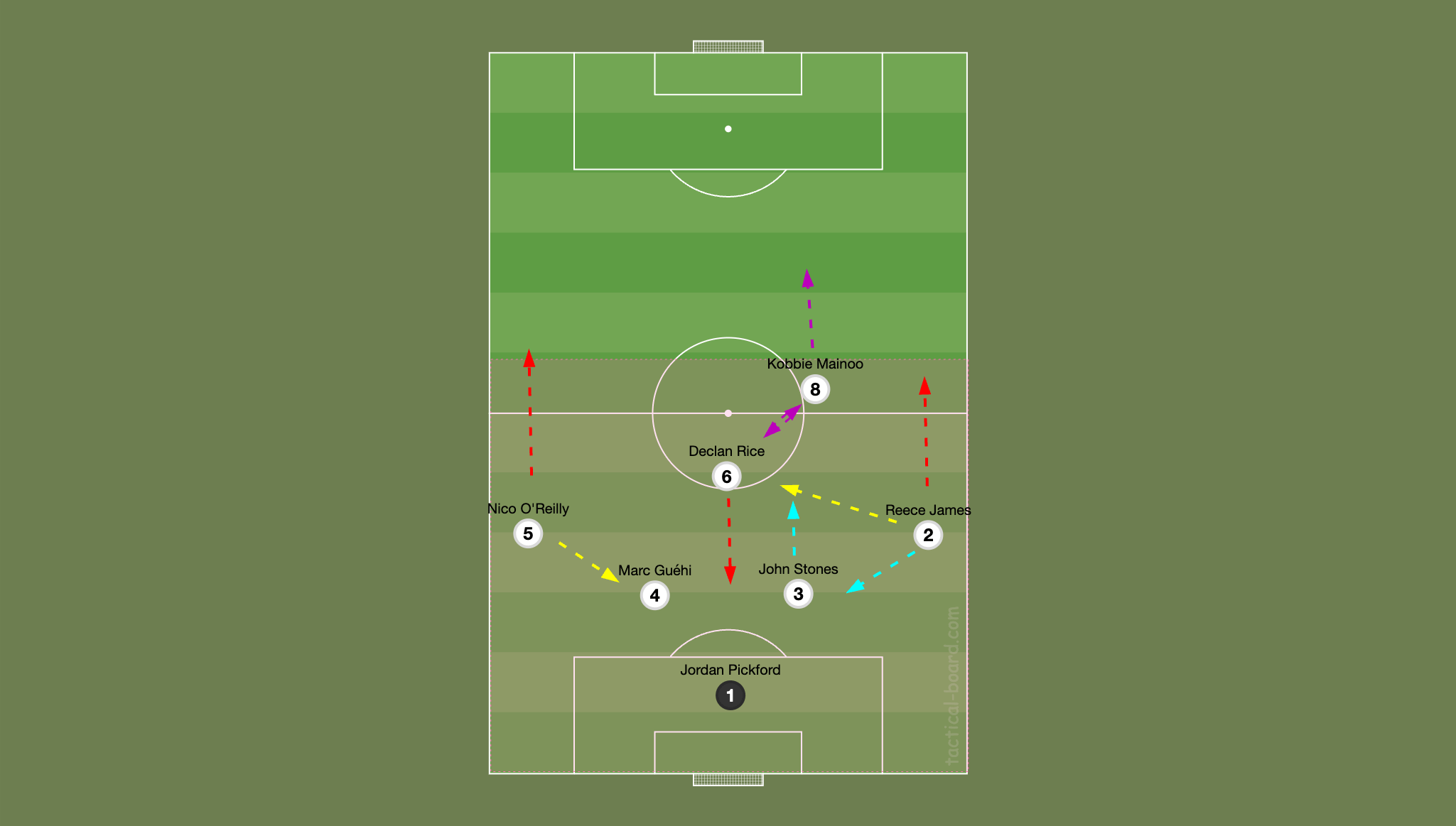
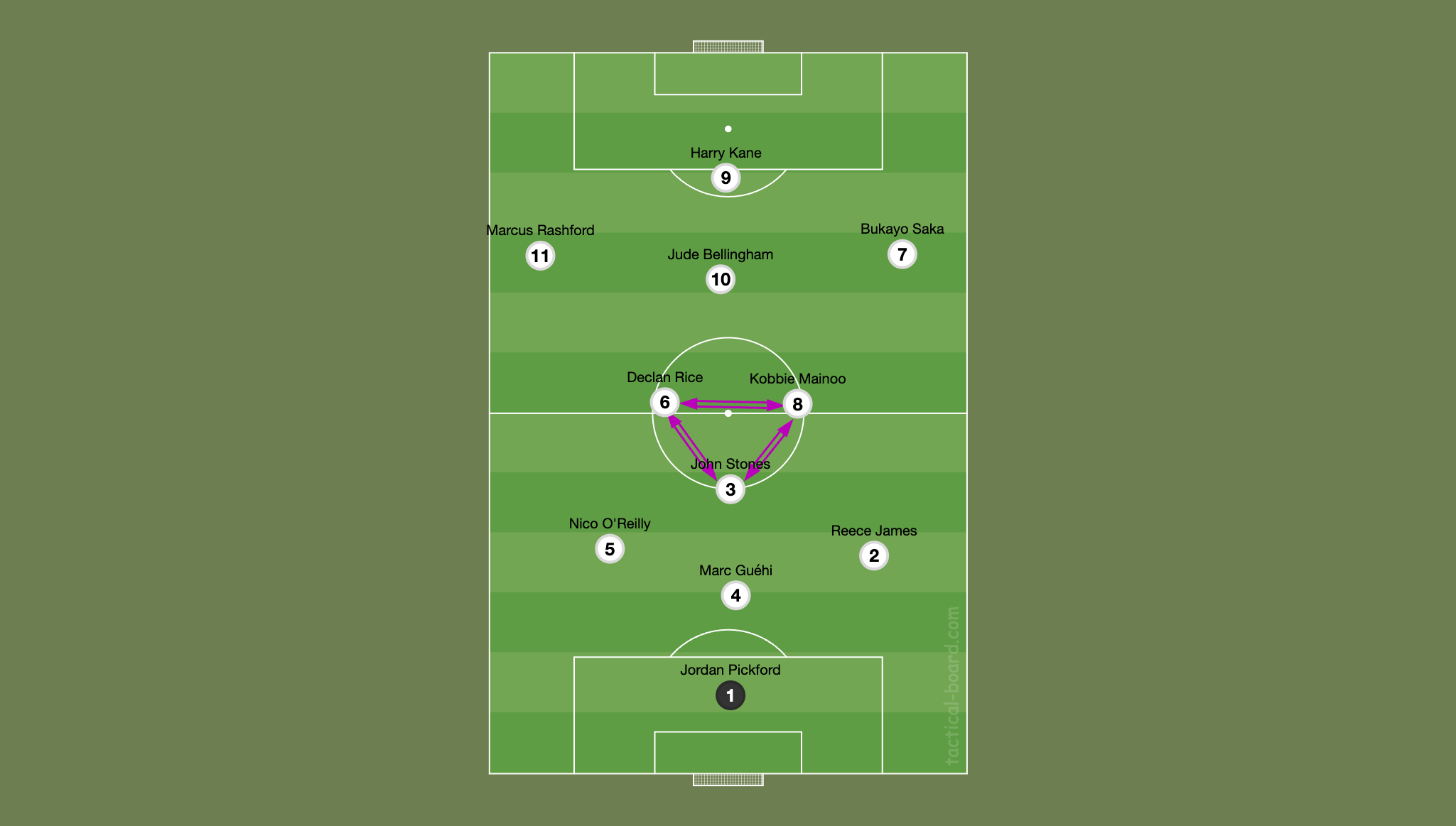
England’s defensive base should not be understood as a fixed back four, nor as a permanent 3-2 buildup shape. Its value comes from rotation.
The purpose of the shifting web is to change who forms the base of England’s rest defence depending on the phase of possession. Rather than asking the same player to anchor, cover, and recover repeatedly, England can distribute those responsibilities across Rice, Mainoo, Stones, James, O’Reilly, and the centre-backs. This prevents the structure from becoming predictable and stops opponents from targeting the same transitional weakness over and over again.
When Declan Rice anchors alone, England can push both full-backs higher, using his range, duel-winning, and recovery instincts as the central safety mechanism underneath the ball. In this version, Rice becomes the reference point that protects the centre while the full-backs stretch the pitch.
When Rice and Kobbie Mainoo operate together, the structure changes. Mainoo can rotate into the deeper midfield line, allowing Rice to step forward into more aggressive pressing or ball-carrying positions. In these moments, one full-back can invert into midfield while the opposite full-back tucks inside to help form the situational back three.
When John Stones steps into midfield, the web shifts again. Stones becomes the temporary extra 6, giving England another layer of circulation and protection, while one of the full-backs drops or narrows to preserve the defensive line behind him. The nominal back four therefore never disappears completely. It simply changes its internal shape.
This is the core principle.
England are not building a static rest defence. They are building a rotating one.
The back four can become a back three through James tucking inside, O’Reilly narrowing, or Stones stepping forward and being covered behind. Rice can anchor, Mainoo can connect, Stones can invert, and the full-backs can alternate between width, midfield support, and defensive security.
The benefit is adaptability.
Against teams that sit deep, England can commit more players forward without abandoning protection underneath the ball. Against transitional sides, they can keep more conservative coverage. Against possession-heavy teams, they can use the extra midfield body to press, compress, and stop the opponent from escaping through central zones.
The shifting web is England’s way of moving beyond rigid role assignment.
It allows the team to remain aggressive without becoming reckless, flexible without becoming chaotic, and direct without reducing the game to one repeated route forward.
The Rotating Pivots
If the shifting web determines who protects England underneath the ball, the rotating pivot determines who controls the next pass forward.
This is where England’s structure becomes especially interesting. Within the same nominal 4-3-3, several players can briefly become a variation of the number six without the team losing its larger shape. Declan Rice, Kobbie Mainoo, John Stones, Reece James, and Nico O’Reilly all offer different versions of midfield security, but each changes the rhythm of the team in a different way.
Rice remains the natural starting point.
As the default anchor, he gives England ball-winning, recovery coverage, and physical authority underneath possession. But the danger is reducing him to only that. Rice is not merely a holding midfielder. He is also a carrier, dueller, presser, and transition runner. If he is permanently chained to the base, England gain security but lose one of their best engines for turning regain into territory.
That is where Mainoo becomes crucial.
Mainoo’s value is not that he replaces Rice as the six, but that he gives Rice permission to stop being only the six. When Mainoo drops deeper, England gain a calmer receiving option who can connect play through tighter spaces. That allows Rice to step forward, press higher, or carry into the next line without abandoning the midfield completely. When Rice holds instead, Mainoo can move into the right-sided interior lane and act as the connective player between the base and the attack.
The same idea applies when Stones, James, or O’Reilly step into midfield.
Each inversion changes the personality of England’s pivot. Stones adds composure and disguised progression. James adds power, crossing threat, and right-sided security. O’Reilly offers a left-sided hybrid profile, capable of supporting Rashford’s inside movements while still giving England a physical presence behind the attack.
The point is not to use every rotation at once, but to create a hierarchy of automatisms.
As international football does not allow endless automatisms. The system must remain simple enough to survive limited training time, tournament pressure, and changing opponents. England therefore need a few repeatable pivot rotations rather than a constantly shifting puzzle.
The principle is controlled flexibility.
England’s midfield base should not be one fixed player in one fixed zone. It should be a rotating reference point shaped by the match state. When England need protection, Rice can anchor. When they need progression, Mainoo or Stones can receive deeper. When they need width and balance, James or O’Reilly can invert selectively.
This allows England to free Rice without exposing the team.
The pivot becomes less of a position and more of a shared responsibility, allowing England to protect, progress, and accelerate without falling back into a rigid version of their own pragmatism.
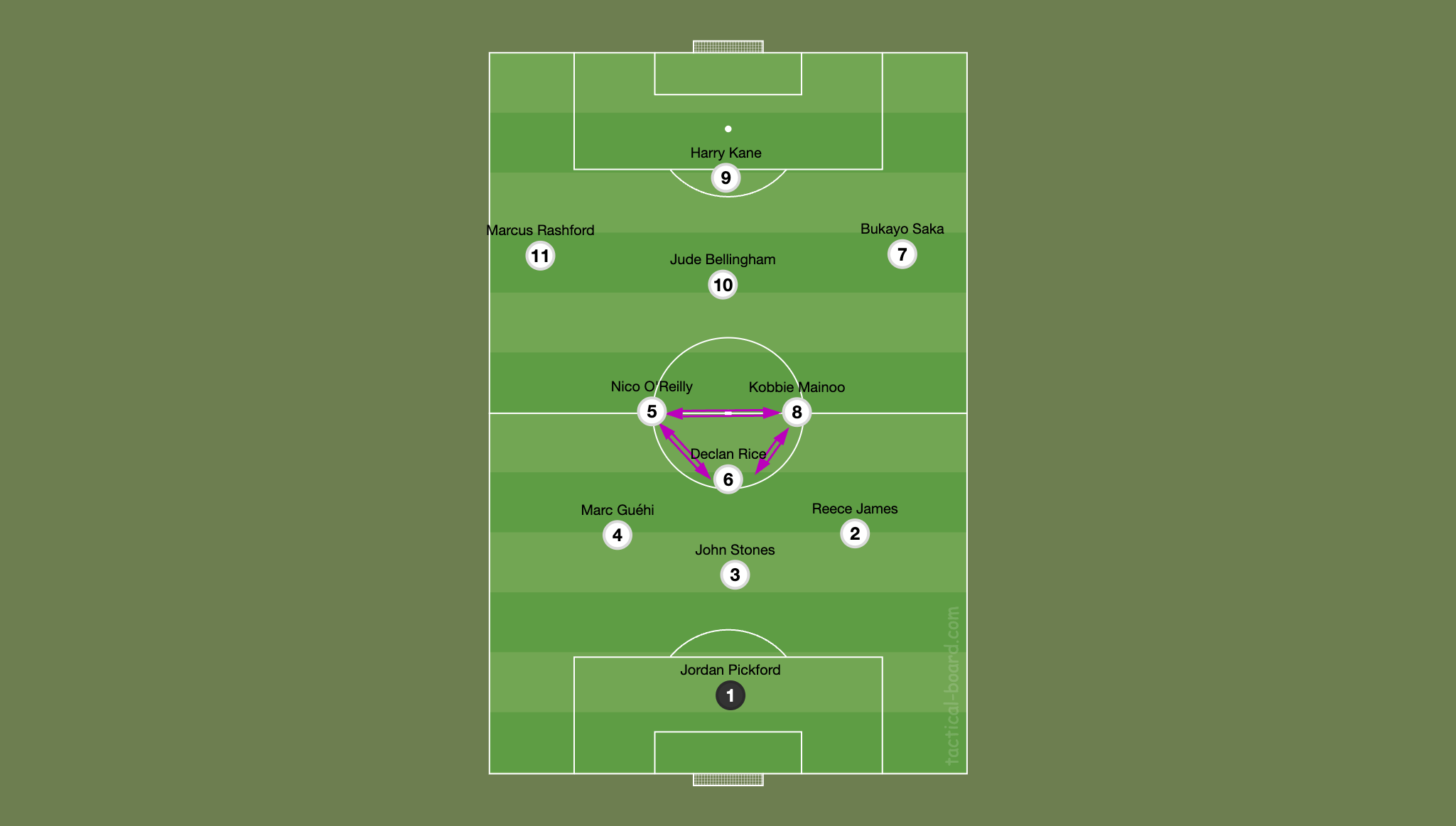
Nico O’Reilly Inverting
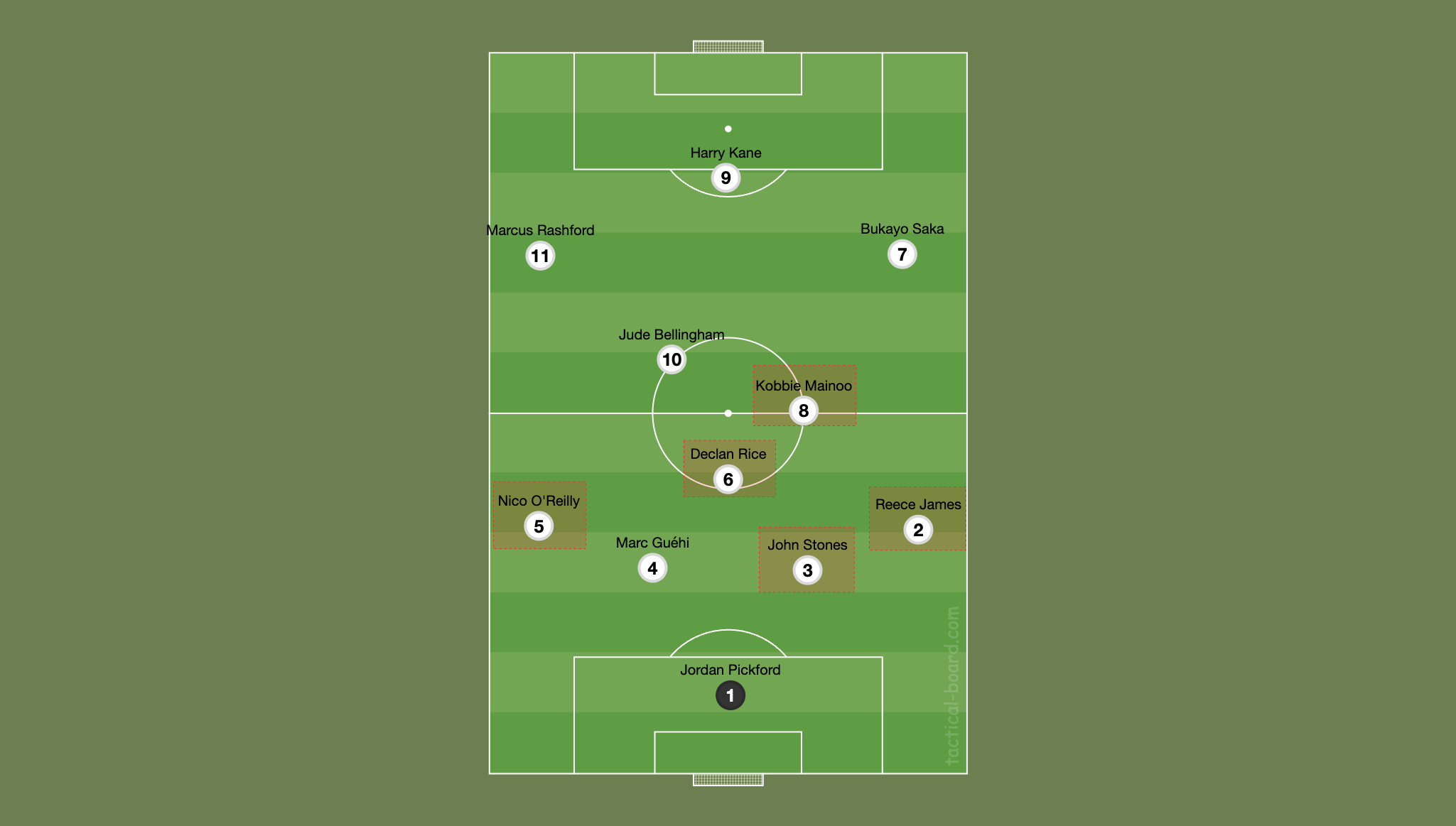
Nico O’Reilly offers England the most creative version of the inverted six role.
Unlike a traditional full-back who steps inside primarily to protect the midfield, O’Reilly carries the instincts of a former attacking midfielder. That background changes the texture of his inversion. When he tucks into central zones, he does not simply become another safety valve underneath possession. He becomes a left-sided technical connector capable of receiving between pressure, supporting combinations, and adding flair to England’s midfield rotation.
His inversion also carries a specific attacking benefit.
Whenever a defender steps into midfield, Jude Bellingham gains greater freedom to occupy the left half-space and zone 14 without being dragged too deeply into buildup. But O’Reilly’s version of that movement adds an extra layer because he can continue his run beyond the first line of circulation. Compared to the other inversion options, he is more naturally suited to crashing the box and arriving in advanced spaces with attacking intent.
That gives England a more fluid midfield three underneath Bellingham.
Rice can anchor or step forward, Mainoo can connect through the right-sided interior lane, and O’Reilly can support from the left as both a stabiliser and late attacking runner. Depending on match conditions, this gives England a softer, more creative route into midfield without completely abandoning physical security behind the ball.
Reece James Inverting
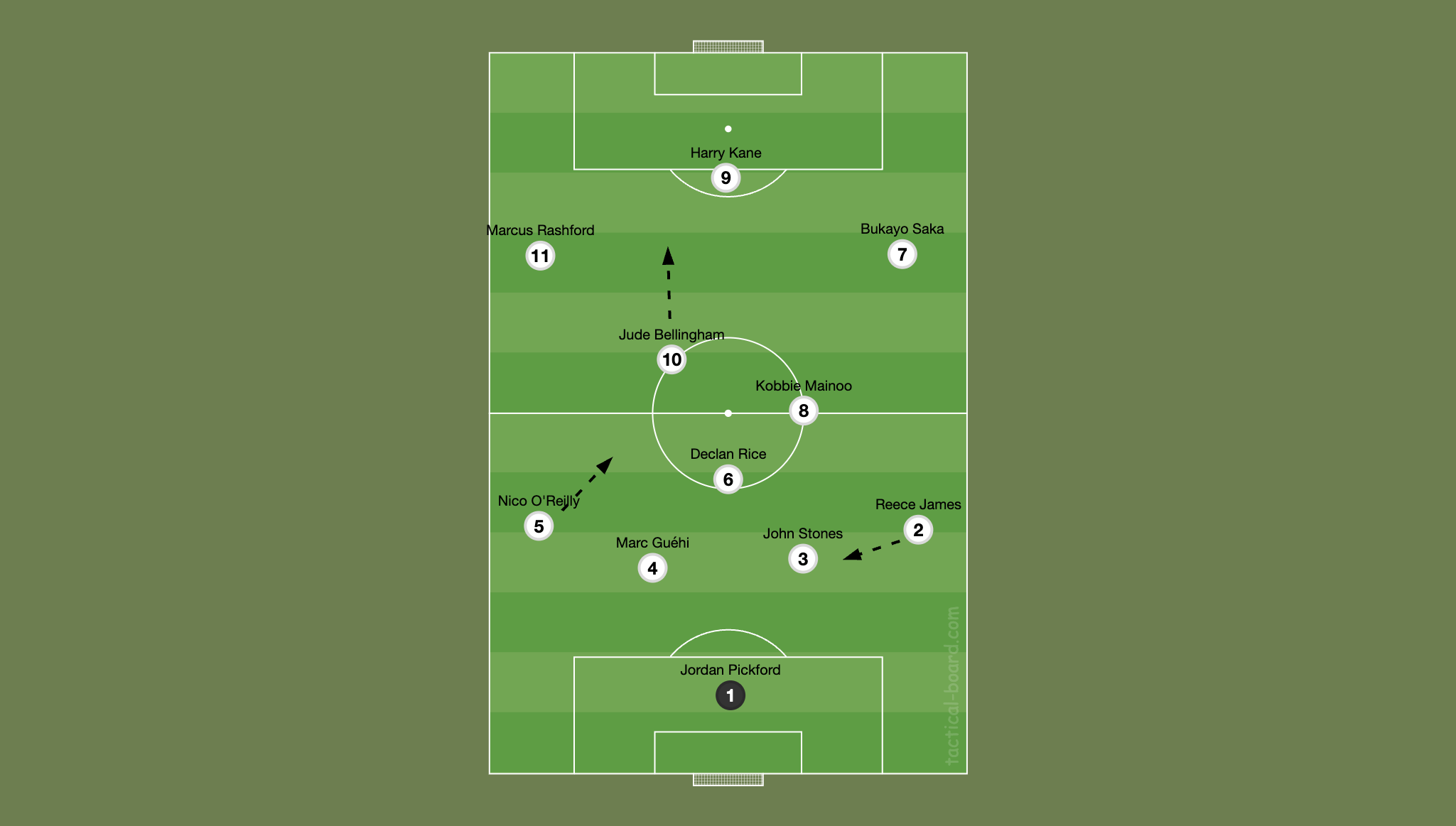
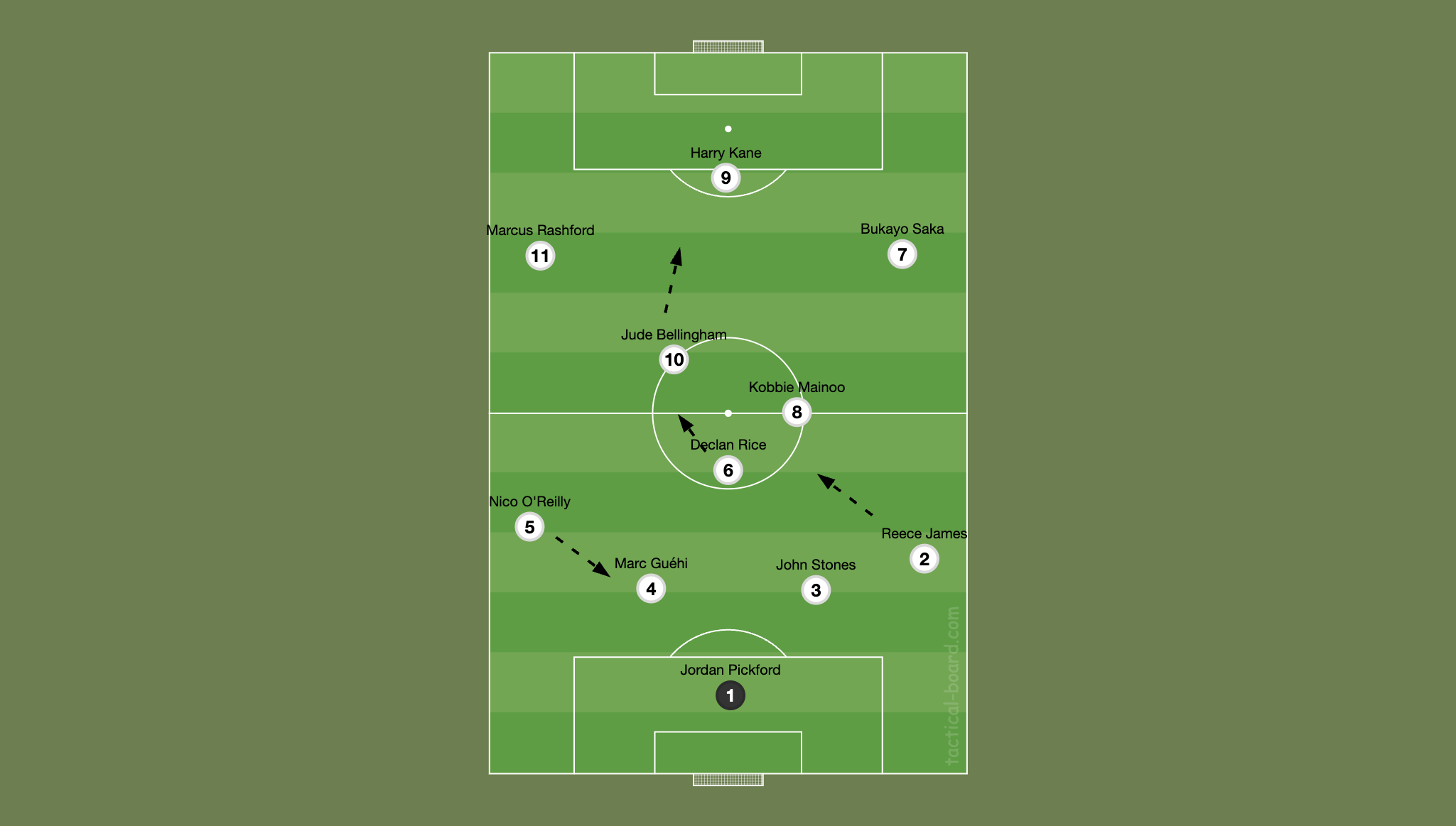
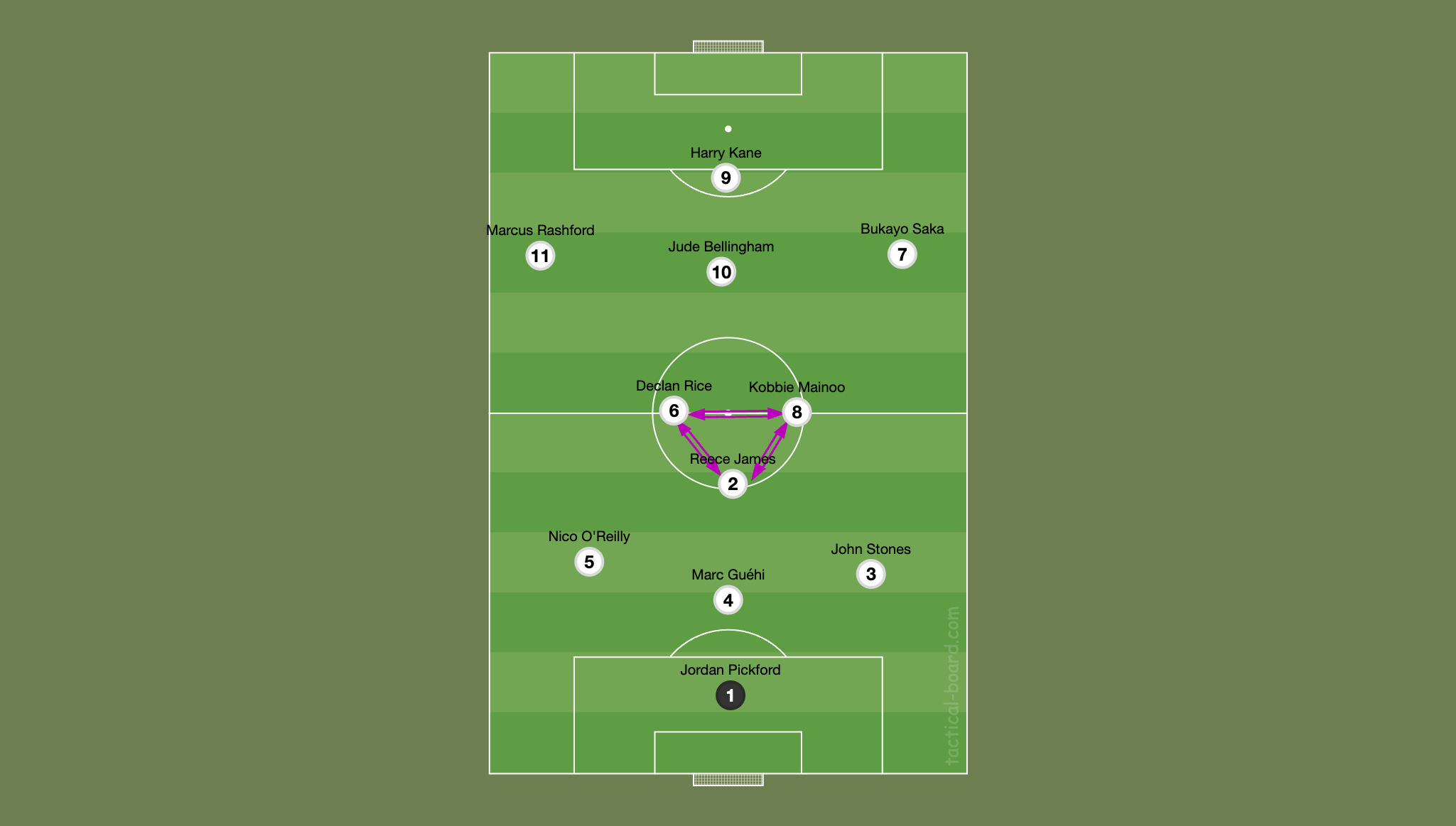
Reece James offers England a more athletic, box-to-box interpretation of the inverted six role.
The principle remains similar: his movement inside helps stabilise the midfield base and gives Jude Bellingham greater freedom to operate higher between the lines. But James changes the personality of the rotation. Where O’Reilly brings a more creative left-sided feel, James brings power, security, ball-striking, and physical authority from the right.
The key differentiator is the range of midfield rotations his inversion creates.
At times, James and Kobbie Mainoo can operate as dual midfield shuttlers, supporting circulation on either side of Declan Rice while giving England more vertical movement through the second line. In this version, Rice becomes the deeper tempo reference, holding the centre while James and Mainoo adjust around him.
In other variations, James’s inversion gives Rice permission to drive forward.
When England require more carry-based verticality, Rice can surge into the left half-space, using his ball-carrying and duel power to break lines rather than simply anchoring underneath possession. James then becomes part of the protective layer behind him, ensuring England do not lose midfield balance when Rice steps out.
This version of the pivot gives England a more physically dominant rhythm.
It does not necessarily maximise delicate creativity, but it increases running power, second-ball coverage, and transitional security. James’s inversion therefore becomes one of England’s best tools for turning the midfield from a static base into a moving platform.
John Stones Inverting
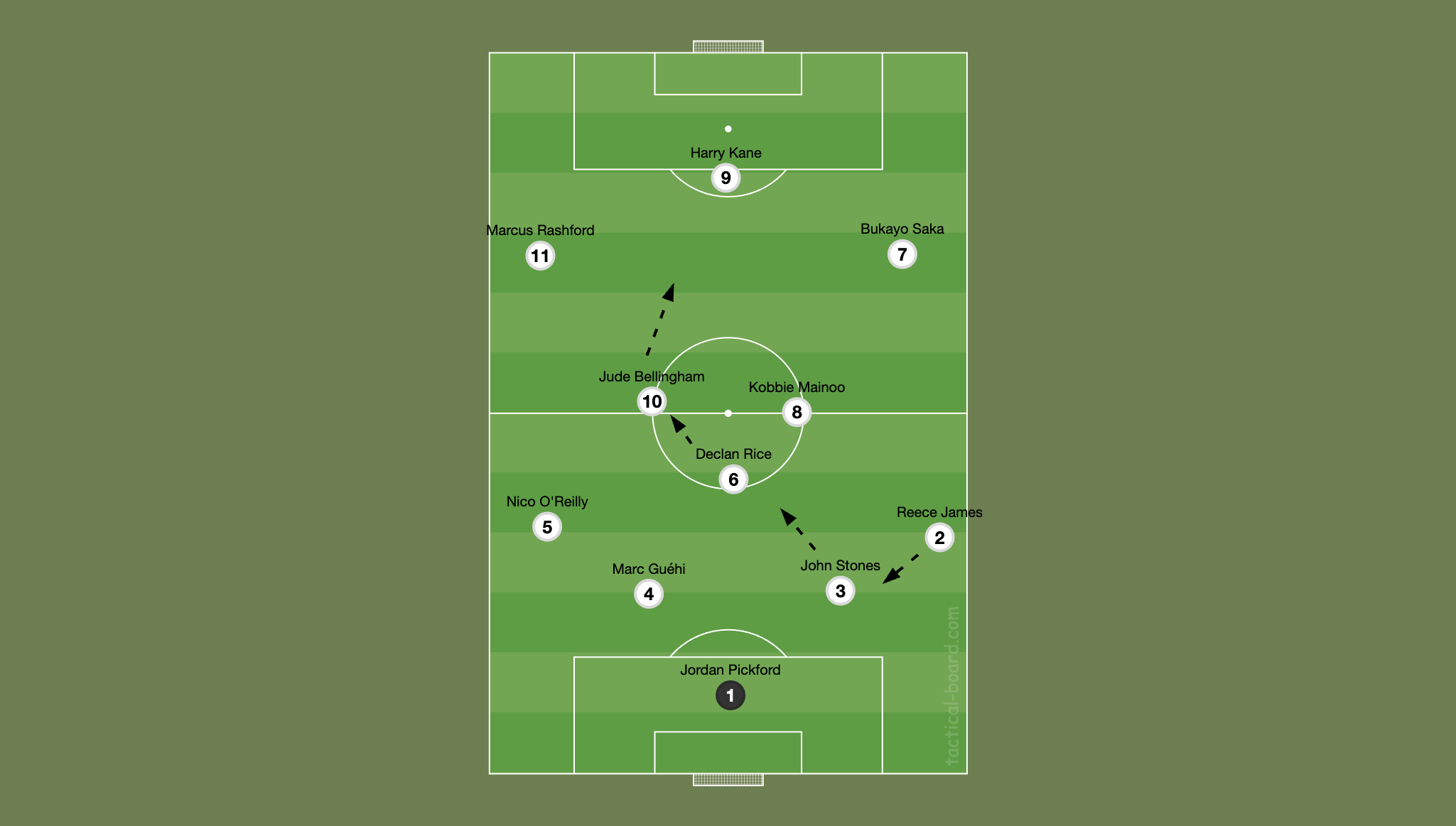
Finally, John Stones offers England the most stabilising version of the rotating pivot.
Unlike Nico O’Reilly or Reece James, Stones’ inversion is less about flair, box-crashing, or wide-to-central dynamism. His movement into midfield creates a more traditional anchoring presence, giving England an extra layer of control underneath the ball while freeing Declan Rice to step forward more aggressively.
In this variation, Stones becomes the cushion.
His role is to secure the structure, absorb pressure, and protect the spaces behind England’s more advanced midfielders. Rather than instilling creative rhythm in the way a natural midfielder might, Stones provides positional calm and defensive intelligence. That allows Rice to use more of his engine higher up the pitch, whether pressing, carrying, or attacking second balls.
There is also a knock-on effect for the left side.
If Stones steps into midfield and England maintain a secure defensive platform behind him, Nico O’Reilly can become more flexible from the left. Rather than always inverting, he may overlap or advance as a wide-centre-back-style support option depending on the phase, giving England another way to balance Rashford’s inward movements.
This is the least chaotic version of England’s rotating pivot, but perhaps the safest.
Stones does not invert to transform the attack directly. He inverts to cushion the structure, allowing the more explosive profiles around him to take risks without the team becoming exposed underneath the ball.
Harry Kane and the Canvas
England’s attacking structure ultimately revolves around the duality of Harry Kane.
At his best, Kane is not merely a traditional striker. He is both the finishing reference point and the deeper attacking organiser, capable of dropping away from the frontline to connect play, dictate passing angles, and release runners into the space he vacates. In a squad lacking a more traditional creative playmaker, this becomes one of England’s most important mechanisms.
The contradiction is obvious.
When Kane drops deeper, England gain clarity between the lines, but lose their most reliable penalty-box presence. When Kane remains high, England preserve their finishing reference point, but risk becoming more dependent on service from wide areas or transitional moments.
The tactical challenge is not choosing one version of Kane permanently.
It is building a canvas around him where both versions can appear at the right moments.
As the Playmaker
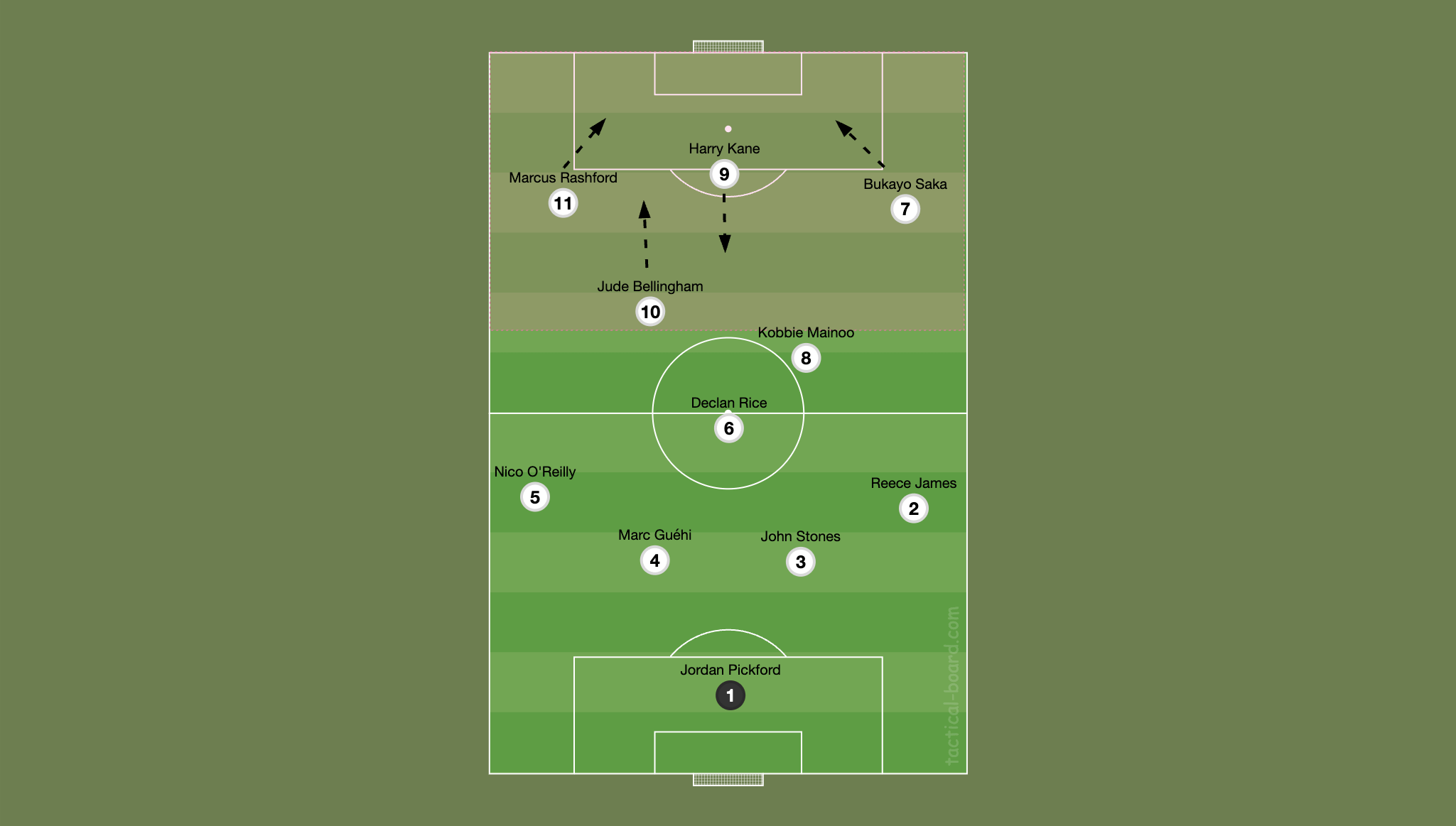
When Kane drops into deeper zones, England gain a temporary playmaking hub between midfield and attack.
His movement naturally pulls centre-backs into uncomfortable decisions. If they follow him, spaces open behind for Marcus Rashford, Bukayo Saka, Jude Bellingham, or one of the rotating midfield runners from England’s fluid six base to attack from deeper positions. If they hold their line, Kane receives time to turn, switch play, or release runners into advanced channels.
This is especially valuable because England’s squad lacks the obvious final-third playmaking profiles of Phil Foden, Cole Palmer, or Trent Alexander-Arnold. Without those more specialised creators, Kane’s passing range and connective intelligence become even more important.
In this version, Kane is the canvas.
Rashford and Saka become vertical runners. Bellingham becomes the box-crashing midfielder arriving beyond the ball. Behind them, England’s rotating pivot structure determines who provides the next wave, whether that is Rice driving forward, Mainoo connecting play, James inverting into midfield, O’Reilly arriving from the left side, or Stones stepping in to secure the structure underneath.
Kane does not need to create every chance directly.
His deeper movement simply allows England’s surrounding profiles to become more dangerous.
As a Traditional 9
The other version of Kane is simpler, but just as important.
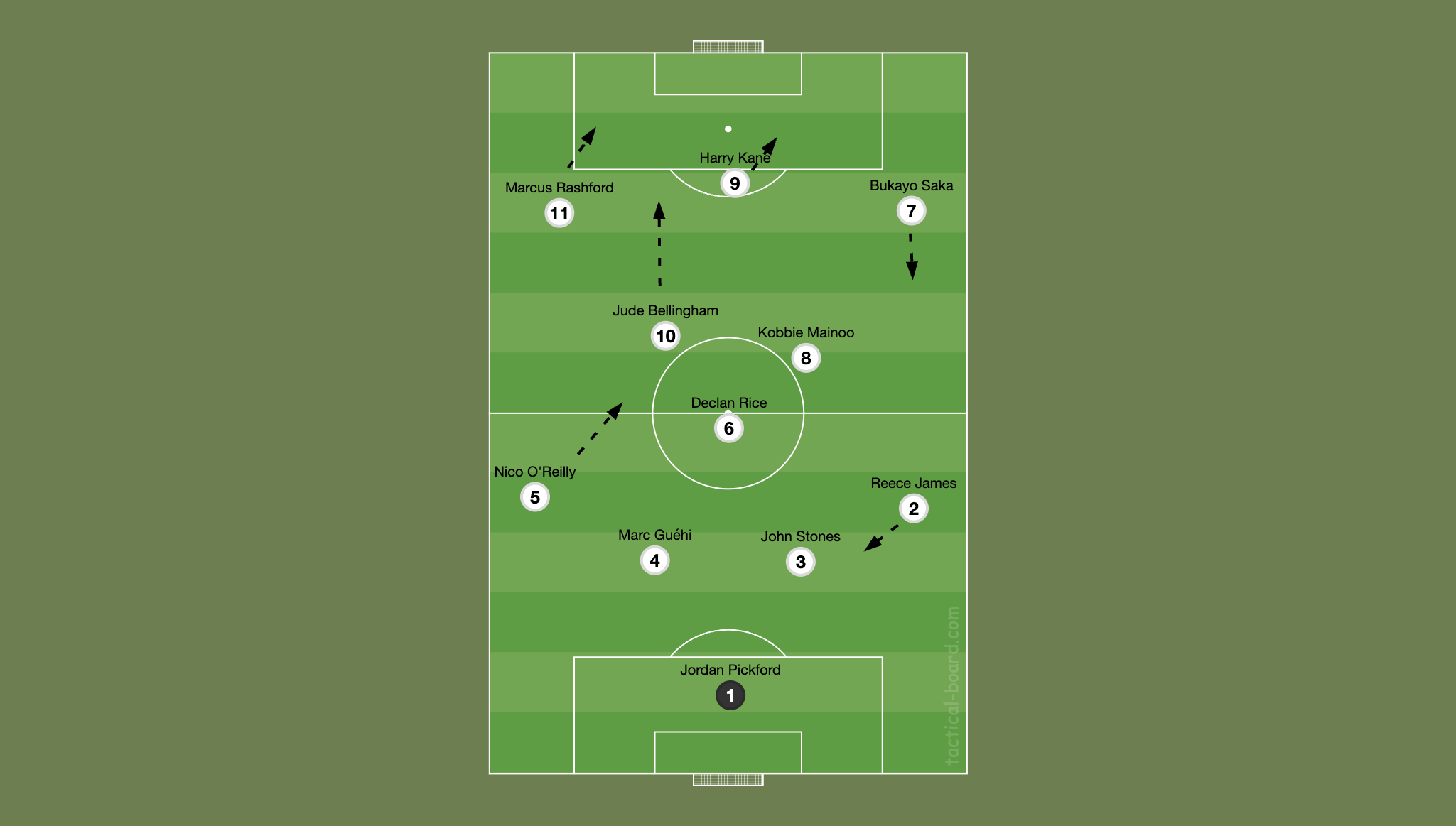
Against deeper blocks, or when England need box presence, Kane must remain closer to the centre-backs and occupy the penalty area more consistently. His finishing, aerial presence, penalty-box intelligence, and ability to pin defenders still give England a reliable focal point when possession becomes slower or more territorial.
This matters because England cannot always rely on transition space.
Against opponents who sit deep, Kane dropping too often can leave England circulating around the box without a true central target. In those moments, his role shifts from connector to reference point. He becomes the player who gives crosses, cutbacks, second balls, and loose rebounds a destination.
This also changes the roles around him.
Rashford can stay wider before attacking the back post. Saka can isolate and deliver from the right. Bellingham can arrive late rather than constantly occupying the highest line. The midfield can recycle possession knowing there is still a true striker occupying the final defensive line.
The ideal England structure therefore does not ask Kane to abandon either identity.
It asks him to alternate between them.
When the game needs connection, Kane becomes the playmaker. When the game needs presence, Kane becomes the 9. England’s ceiling may depend on how well Tuchel builds the surrounding canvas so Kane’s movement creates advantages rather than absences.
Best-Case XI
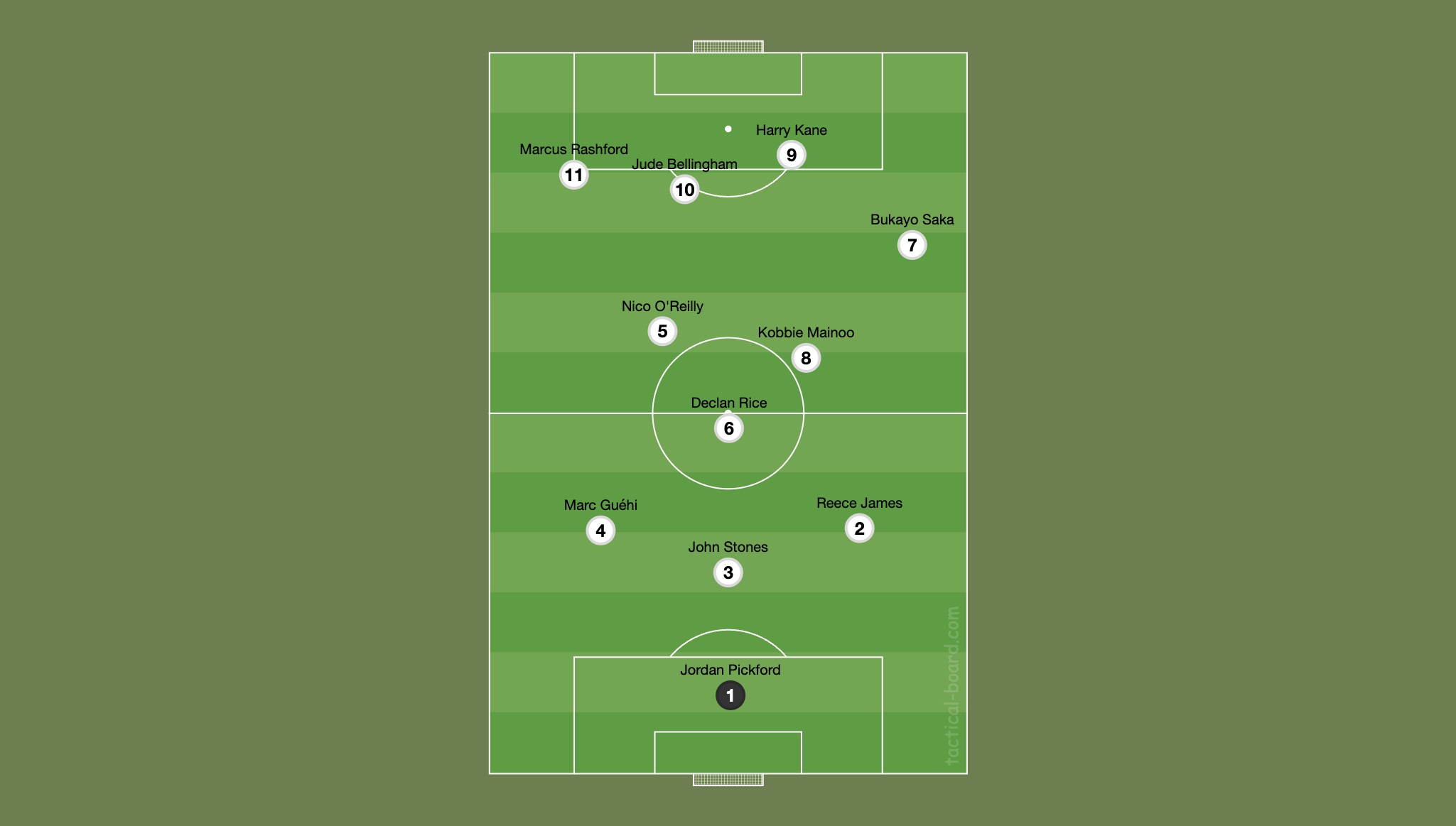
Within the constraints of the announced squad, England’s strongest tournament structure depends on turning positional flexibility into collective balance.
The objective is not simply to fit the best names together, but to build a system where England’s multi-traited players can shift responsibility without creating structural confusion. Declan Rice remains the key reference point, but the system should not trap him as a static anchor. His value comes from the duality of being both a stabiliser and a carrier.
That is where England’s rotating pivot structure becomes central.
John Stones, Reece James, Nico O’Reilly, Kobbie Mainoo, and Rice all offer different versions of midfield security. Stones provides the defensive cushion, James adds athletic inversion from the right, O’Reilly offers a more aggressive left-sided option, and Mainoo connects possession between phases. Together, they allow England to protect the structure while still freeing Rice and Jude Bellingham to influence higher zones.
Ahead of them, Harry Kane becomes the attacking canvas.
When Kane drops, England gain a temporary playmaking hub capable of releasing Rashford, Saka, Bellingham, or one of the rotating midfield runners into space. When he stays high, England retain their most reliable penalty-box presence. The key is not choosing between Kane the creator and Kane the finisher, but building a structure that allows both versions to appear depending on match state.
Ultimately, England’s ceiling depends on modernising their traditional strengths rather than rejecting them.
This is still a side built to run, duel, press, cross, and attack space. But beyond the three passes, those traits must be placed inside a structure flexible enough to survive different tournament conditions.

Tournament Outlook
Looking ahead to the 2026 World Cup, the familiar question inevitably returns.
Could this finally be England’s year?
For generations, English football has lived with the idea of the game “coming home.” Yet since the formation of the Football Association and the global spread of the modern game, football has travelled far beyond its original shores. It has absorbed new cultures, new tactical languages, and new interpretations of control, expression, structure, and risk.
In that sense, England’s challenge in 2026 is not simply to bring football home.
It is to show what English football has learned since it left.
That is why the adaptability spectrum becomes the defining test of their tournament. England will not be judged purely by whether they can play directly, dominate possession, press high, or survive pressure. They will be judged by whether they can recognise which version of themselves each match requires.
That is where this generation becomes fascinating.
England possess players who are technically educated, physically powerful, and tactically flexible. Declan Rice can anchor or drive. Jude Bellingham can connect, crash, and press. Harry Kane can create or finish. Reece James, John Stones, Kobbie Mainoo, and Nico O’Reilly can all alter the structure underneath the ball. This is not a squad short on tools.
The question is whether those tools become a coherent identity.
England have already reached the latter stages of major tournaments, but their final step requires more than moments, emotional surges, or individual quality. It requires a system capable of carrying English football’s traditional strengths into the modern game without becoming trapped by them.
Not just directness.
Not just control.
Not just physicality.
Not just moments.
The best version of England must carry all of those qualities at once.
Beyond the three passes does not mean abandoning English football’s edge. It means understanding that edge as one weapon within a wider tactical language.
Only then can football truly find its way home.