Portugal’s Systemic Ceiling
National Blueprints, World Cup 2026: Portugal

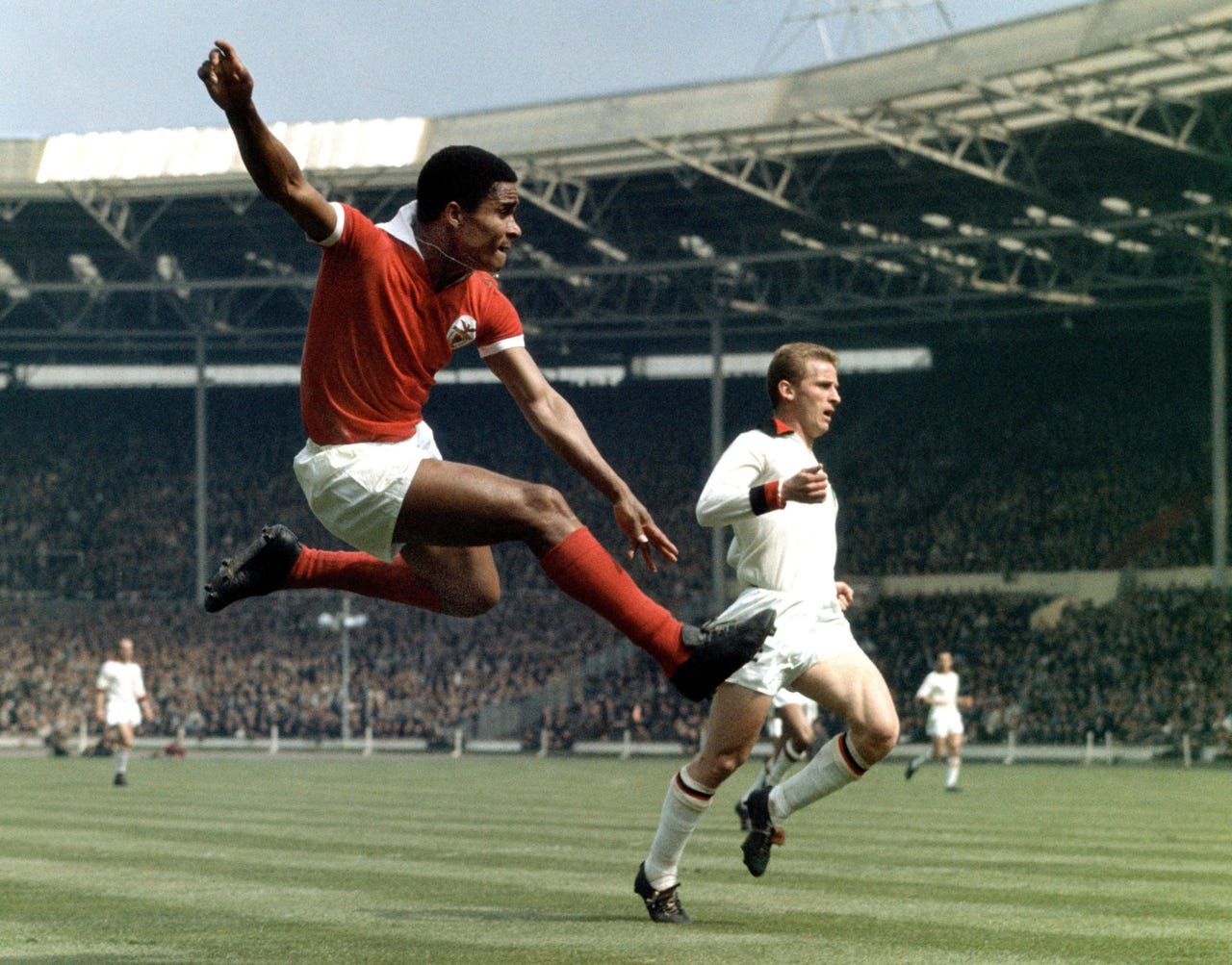
Portuguese football has long been associated with technical brilliance, flair, and iconic individuals. From Eusébio’s legendary 1966 campaign, to Luís Figo and Rui Costa’s Golden Generation, to Cristiano Ronaldo’s era-defining longevity, Portugal have consistently produced some of football’s most gifted talents. Yet despite reaching multiple semi-finals across generations, they remain one of international football’s great near-myths: a historic footballing nation still searching for its first World Cup final.
Ahead of the 2026 World Cup, however, Portugal arrive differently.
In the last decade alone, they have won their first European Championship, the inaugural UEFA Nations League, and now a second Nations League title. More importantly, they may possess the most systemically complete squad in their history. Built around technical security, positional intelligence, and rotational fluidity, this new generation represents a shift away from dependence on singular brilliance and towards collective control.
And yet, one final question remains unresolved.
Cristiano Ronaldo, the final remaining bridge to Portugal’s previous era, still stands at the centre of the national team’s identity. But as tournament football becomes increasingly defined by pressing structures, midfield compactness, and collective intensity, Portugal face a dilemma larger than any individual player:
Can their new systemic generation fully emerge while still orbiting around the gravity of the old one?
Identity & Historical Context
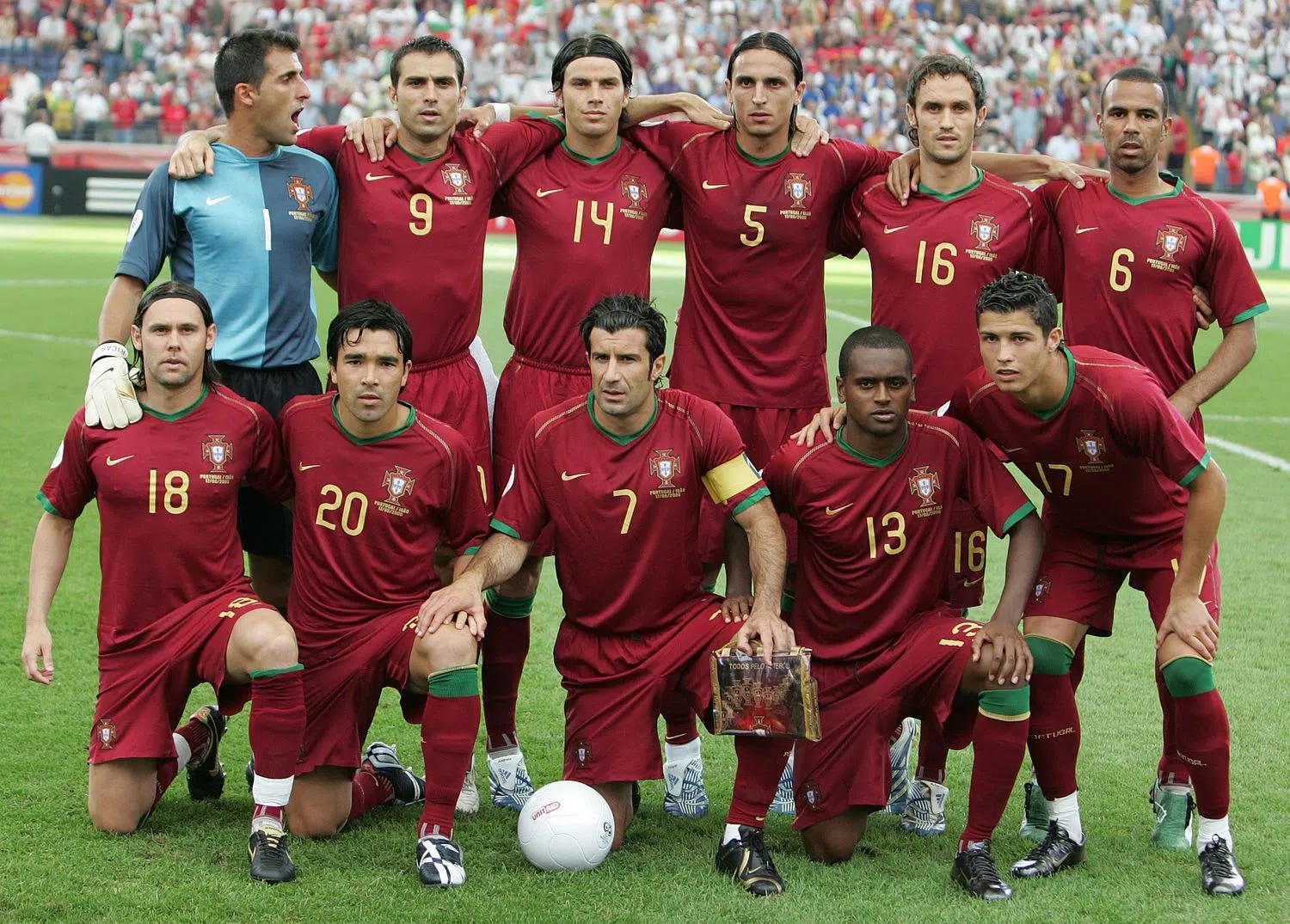
Portugal’s footballing history has often been remembered through individuals. Eusébio. Figo. Rui Costa. Cristiano Ronaldo. Even UEFA’s own retrospective framing of Portugal leans heavily into technical artistry, emotional moments, and generational talent. Yet beneath those iconic figures, Portuguese football has quietly spent decades evolving into one of the sport’s most intellectually adaptive ecosystems.

From the influence of foreign coaches and tactical cross-pollination in the early professional era, to the emergence of José Mourinho and Vítor Frade’s tactical periodisation model, Portugal became one of the central laboratories of modern football thinking in the 21st century. Portuguese coaching itself no longer represents a singular ideology. Instead, it has become remarkably diverse: positional play, transition football, compact low blocks, aggressive pressing structures, relational attacking systems, and hybrid models all coexist within the country’s football culture.
That tactical flexibility has long produced historic club successes. Porto’s Champions League triumph under Mourinho. Benfica’s recurring European competitiveness. Sporting CP’s developmental pipeline. Yet only recently has that systemic sophistication begun fully translating to the national team level.
In the last decade, Portugal have won their first European Championship, the inaugural UEFA Nations League, and now a second Nations League title. More importantly, they may possess the most structurally complete squad in their history: a generation built less around isolated brilliance and more around technical permanence, rotational intelligence, and collective control.
And yet, that evolution creates a new contradiction.
For perhaps the first time in modern Portuguese football history, the national team may be tactically larger than any single individual within it.
The Modern Problem
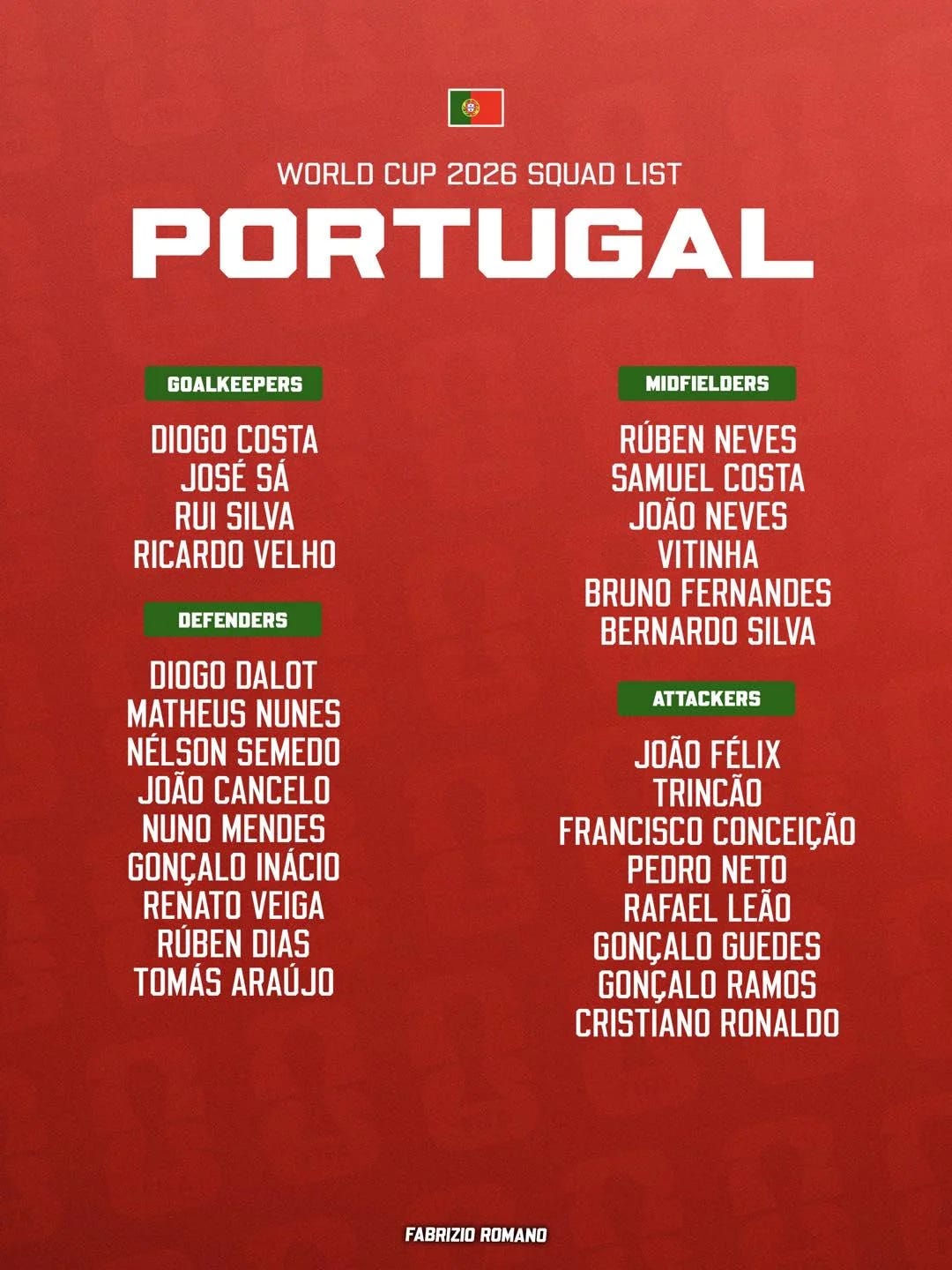
Ahead of the 2026 World Cup, Portugal have announced perhaps the deepest and most technically gifted squad in their modern history. On paper, the profile balance appears almost ideal: elite ball-playing defenders, highly intelligent midfield controllers, explosive wide threats, and multiple attacking options capable of operating across fluid structures.
Yet beneath that technical abundance lies a more difficult question.
Modern tournament football increasingly rewards collective intensity, compactness, rotational intelligence, and off-ball coordination. Portugal possess those qualities across much of the squad. However, the team’s central dilemma remains whether those principles can fully coexist with the gravitational pull of Cristiano Ronaldo’s role within the national side.
This is not simply a debate about goals, reputation, or legacy. It is a structural problem.
The Midfield Contradiction
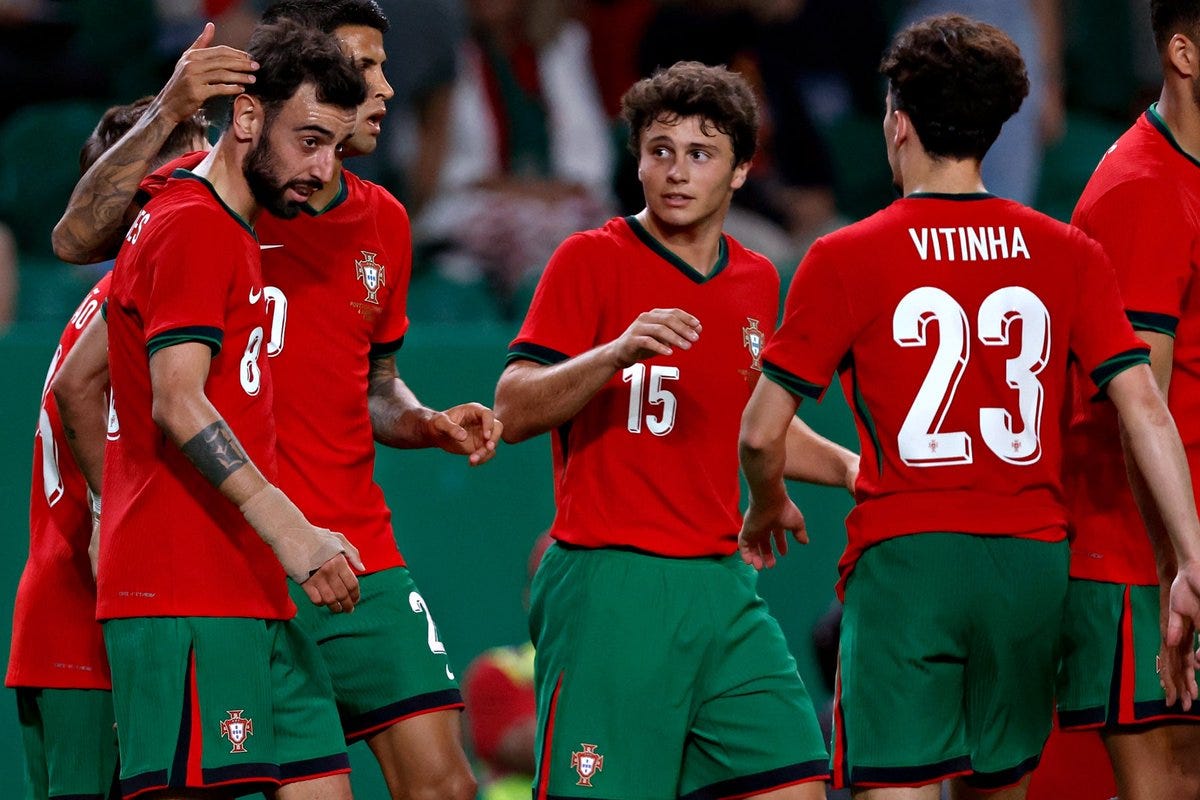
Portugal’s midfield may be the most technically secure unit at the 2026 World Cup. Vitinha, João Neves, Bruno Fernandes, Bernardo Silva, and Rúben Neves all offer elite-level qualities in circulation, press resistance, creativity, tempo control, and positional intelligence. Even off the ball, the collective work rate of the group remains extremely high, particularly through João Neves’s relentless pressing intensity and Bernardo Silva’s tireless defensive coverage.
Yet modern tournament football is not decided purely through technical security.
Among Portugal’s nominal midfield options, Samuel Costa is the only true destructive profile: a natural duel-winner capable of physically disrupting transitions and stabilising defensive chaos through aggression rather than circulation. The rest of the midfield operates through anticipation, intelligence, and collective positioning more than brute force.
That creates Portugal’s central dilemma.
Against elite opposition, particularly in the latter stages of a World Cup where midfield spaces compress and physical intensity rises, technical superiority alone may not guarantee territorial control. Portugal’s solution, therefore, cannot simply be to outmuscle opponents. Instead, they must attempt to suffocate matches through possession permanence, rotational compactness, and high territorial pressure before physical transitions can emerge in the first place.
The Ronaldo Contradiction
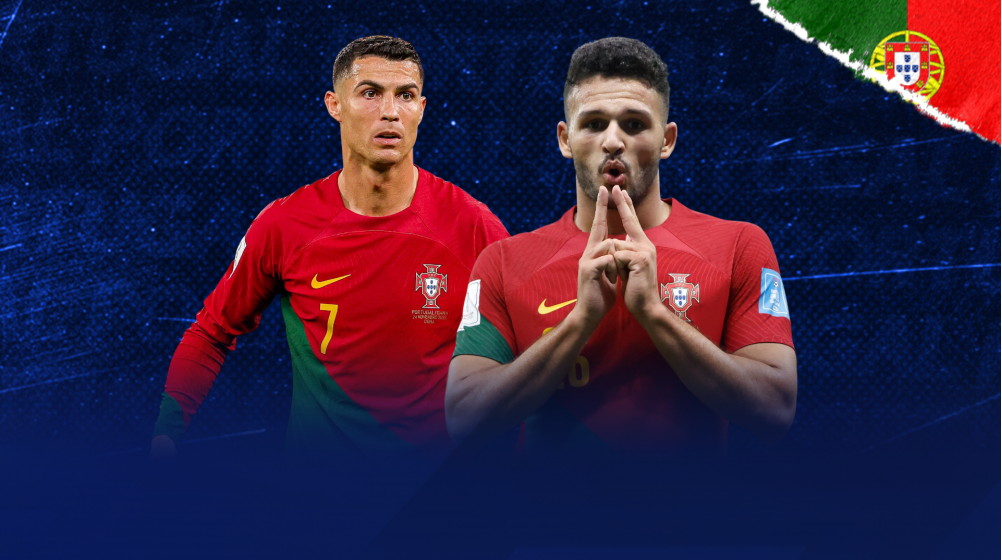
Portugal’s most difficult tactical question is also its most emotional one. Cristiano Ronaldo remains one of football’s greatest ever penalty-box threats, capable of deciding matches through movement, finishing instinct, aerial dominance, and sheer psychological gravity alone. Against weaker group-stage opposition, those qualities can still overwhelm defensive structures.
Yet modern elite football increasingly asks something different from its centre forwards.
At the latter stages of tournaments, midfield spaces compress, defensive lines tighten, and attacking service becomes significantly harder to sustain. In those moments, strikers are often required to become the first line of defensive pressure, dropping into midfield zones, pressing centre-backs aggressively, and contributing to territorial control off the ball. Gonçalo Ramos naturally fits that modern profile through his relentless pressing intensity, connective movement, and willingness to physically occupy defenders from the front.
Ronaldo’s evolution into a more static penalty-box presence creates a structural trade-off. Portugal gain elite finishing gravity, but risk losing collective compactness and midfield protection out of possession. Against the strongest sides in the tournament, that imbalance can become increasingly difficult to sustain over ninety minutes.
And beyond tactics, there remains the deeper psychological reality. Ronaldo’s stature within Portuguese football is so immense that it naturally shapes the behaviour of the squad around him. The younger generation grew up idolising him, creating an unspoken hierarchy where the system itself can begin orbiting around his presence. In many ways, Portugal’s greatest challenge ahead of 2026 may not simply be tactical, but whether their new systemic generation can fully emerge while still carrying the gravity of the previous one.
The Width Contradiction
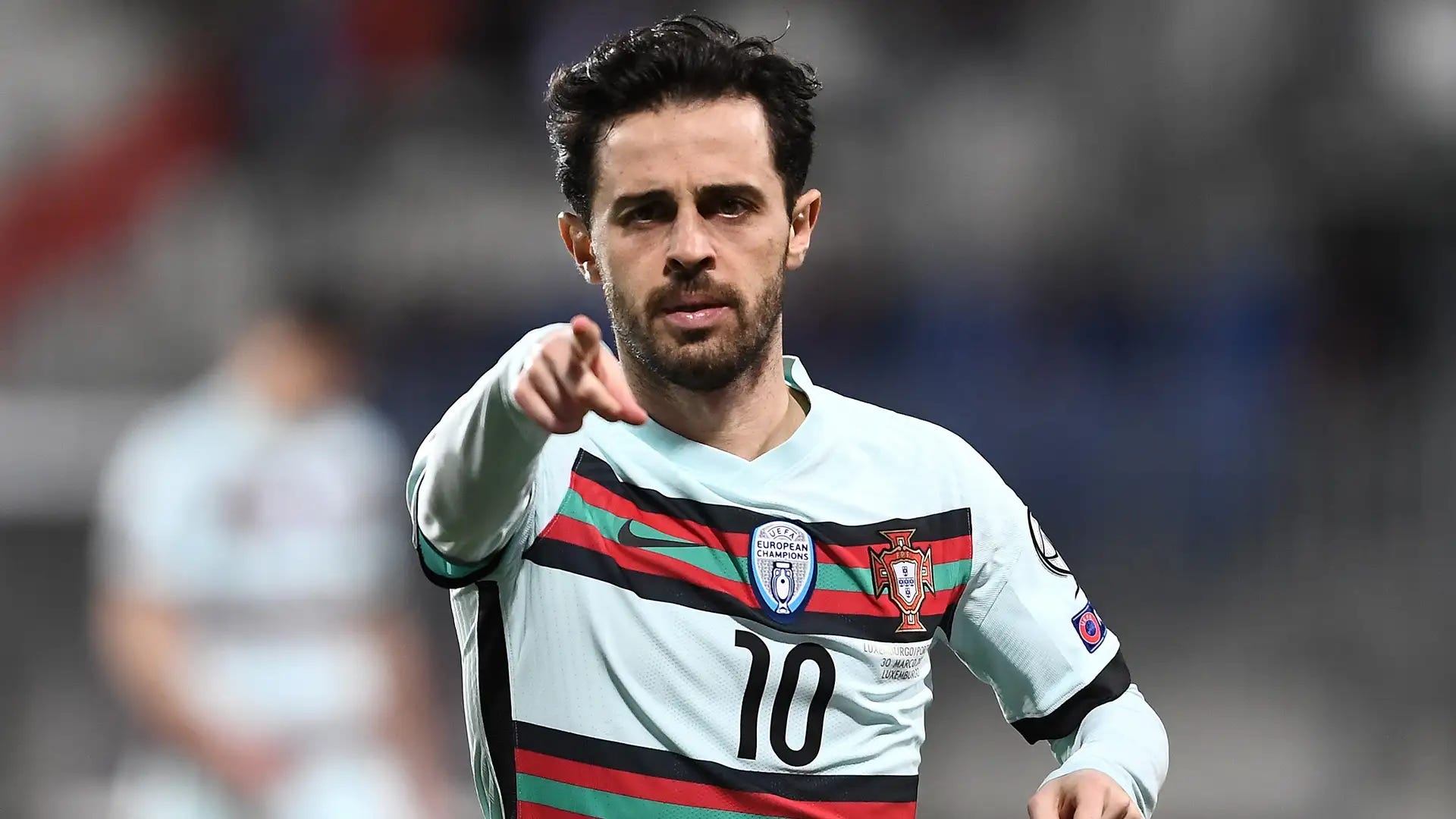
Portugal’s wide structure presents another layer of tactical tension. Among the forward profiles, Bernardo Silva is no longer a traditional touchline winger, nor does he fully operate as an explosive inside forward capable of consistently attacking space through raw pace. Instead, he functions primarily as a wide playmaker and tempo controller, naturally drifting into interior zones to stabilise circulation and combine centrally.
The rest of Portugal’s attacking profiles further complicate the picture. Players such as Pedro Neto, Rafael Leão, Francisco Conceição, and João Félix all operate through different interpretations of width: some as direct dribblers, some as inverted forwards attacking diagonally, and others as hybrid creators seeking interior combinations rather than permanently holding the touchline.
That reality increasingly shifts the responsibility for true width creation onto the full-backs.
Modern football often relies on wing-backs and full-backs to stretch defensive structures horizontally, and Portugal possess a highly diverse collection of profiles in those roles. On the left stands Nuno Mendes, arguably the squad’s most complete transition weapon: defensively elite, athletically devastating, and capable of operating both as a stabilising defender or an aggressive final-third penetrator. On the right, Diogo Dalot offers an attack-first interpretation of the position, aggressively flooding the wide channel and attacking space vertically. Matheus Nunes presents a more hybrid solution, blending inverted movements with transitional carrying, while João Cancelo remains one of the most tactically flexible full-backs in world football, capable of inverting centrally or overlapping traditionally depending on the system around him.
That creates Portugal’s width dilemma.
Do the full-backs remain conservative to secure the rest-defense structure and protect transitional spaces? Or do they fully embrace aggressive penetration, maximising the very qualities that make them elite attacking weapons?
In many ways, Portugal’s attacking ceiling may ultimately depend on how they balance those trade-offs, particularly on the right side where Bernardo Silva’s interior tendencies naturally leave space available for a more aggressive overlapping presence.
The Tournament Contradiction
International football introduces a very different tactical reality compared to club football. National teams simply do not have the same level of training time, automatisms, or week-to-week structural repetition that elite club systems rely upon. As a result, tournament football often becomes less about mastering one singular idea and more about executing many aspects of the game to a consistently high and adaptable level.
For Portugal, that reality creates both opportunity and danger.
Their technical quality offers a potential solution to the lack of long-term cohesion. Through circulation, positional intelligence, and collective press resistance, Portugal can attempt to slow matches down, suffocate opponents territorially, and psychologically exhaust teams by forcing them to defend for extended periods. In many ways, their midfield structure is designed not simply to dominate possession, but to make matches feel increasingly long for the opposition.
Yet technical dominance always carries a risk.
If Portugal lose control of circulation, the consequences can become catastrophic against more physically aggressive sides capable of attacking quickly through transitions or set pieces. Because the squad lacks overwhelming midfield destruction physically, moments of technical breakdown can leave the defensive structure exposed before it fully resets.
That tension becomes particularly important when analysing Portugal’s tournament pathway.
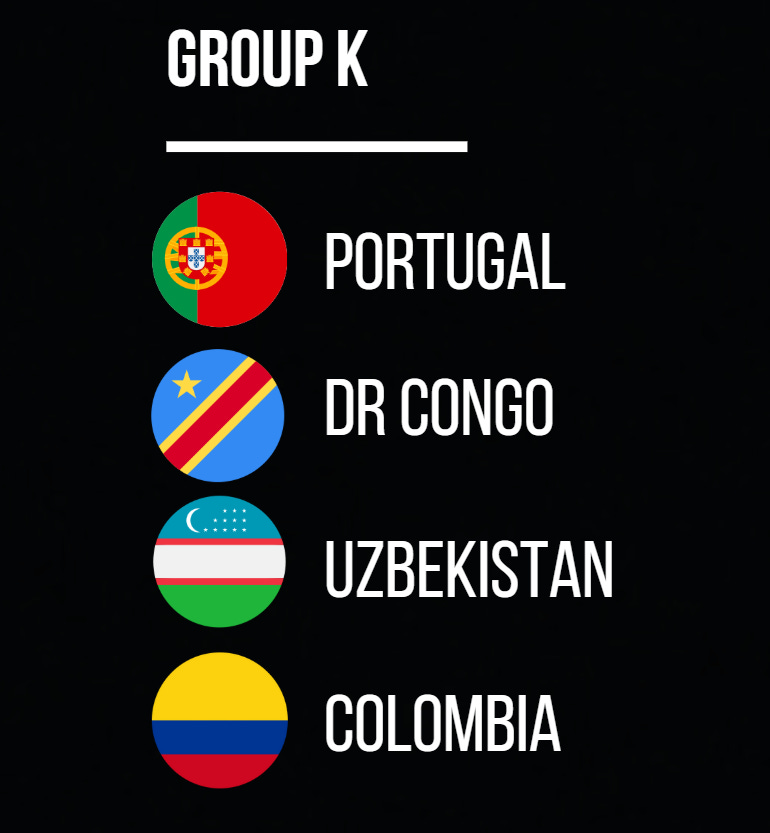
In the group stage, Colombia represent the most complete challenge on paper due to their transitional quality and physical intensity. Unlike deeper defensive sides purely seeking survival, Colombia possess enough attacking ambition to actively challenge Portugal territorially rather than simply defend for a draw.
The other two opponents, Uzbekistan and DR Congo, may approach matches more pragmatically, particularly under the modern third-place qualification format where draws can hold significant tournament value. Those matches may naturally produce lower defensive lines, longer spells of Portuguese possession, and more sustained territorial pressure. In those scenarios, Cristiano Ronaldo’s penalty-box gravity and elite chance conversion remain highly valuable, as Portugal are likely to generate a far greater volume of final-third situations and crossing sequences.
The greater danger emerges later.
As knockout football progresses, midfield battles tighten, defensive spacing improves, and technical margins shrink dramatically. Against elite opposition, possession alone no longer guarantees control. Support structures across the pitch must become increasingly synchronised, pressing distances more compact, and off-ball contributions more precise. In those moments, Portugal’s entire tactical blueprint will ultimately be tested: can technical permanence survive when the physical and psychological chaos of knockout football begins closing in around it?
The Tactical Proposal
Portugal’s challenge is not simply to assemble their best individual players onto the pitch. It is to construct a system capable of protecting their physical vulnerabilities while maximising the overwhelming technical intelligence distributed throughout the squad.
That solution begins with control.
Not passive possession, but territorial control. Rotational control. Psychological control. A structure designed to suffocate transitions before they emerge, compress the match into the opposition’s half, and force opponents into defending for prolonged stretches without relief.
This is the proposed blueprint.
Building the Base
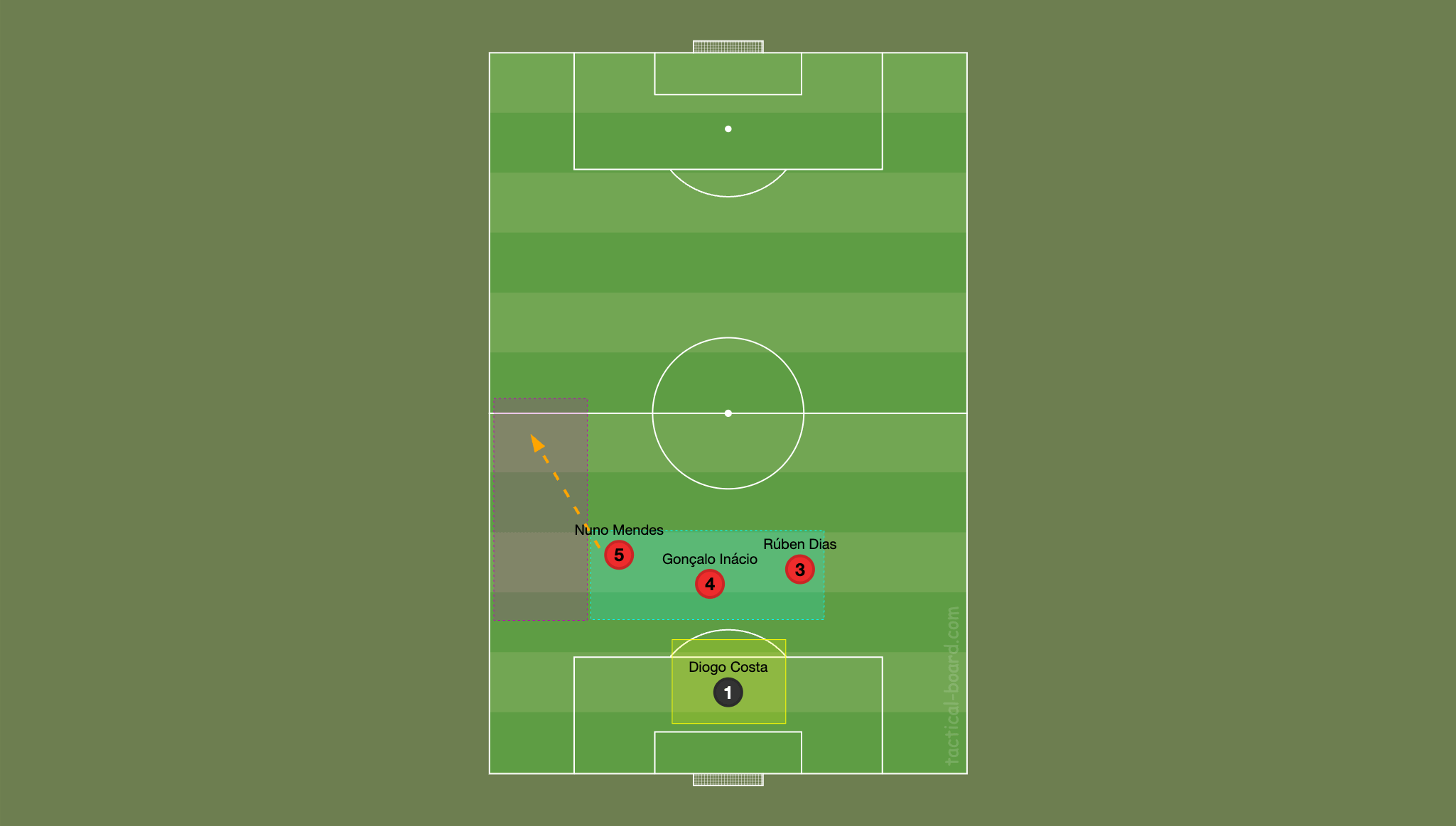
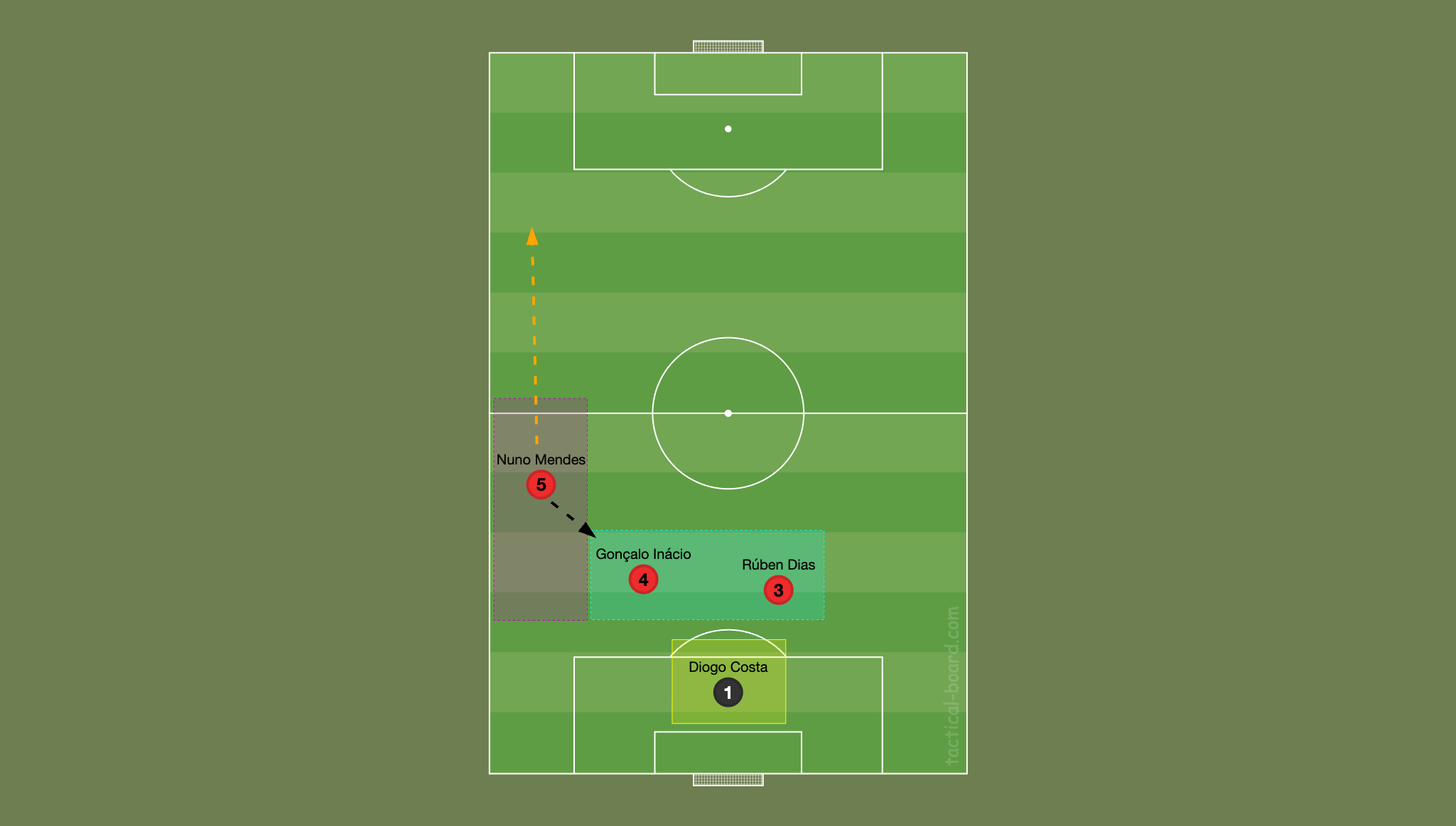
The foundation of this structure begins deep in possession. Diogo Costa remains one of the most technically secure goalkeepers in international football, capable not only of shot-stopping but actively sustaining circulation under pressure. Ahead of him, Rúben Dias and Gonçalo Inácio form a centre-back pairing built less around emergency defending and more around progression, spacing, and territorial advancement through the first phase.
From there, the structure becomes fluid.
At times, Nuno Mendes may remain deeper alongside the centre-backs to stabilise defensive transitions and protect against counters. In other moments, either Vitinha or João Neves can temporarily drop into the base structure, freeing Mendes to aggressively attack higher zones through third-man runs and wide penetrations. That rotational flexibility becomes essential to maintaining numerical superiority during circulation while still preserving transitional protection behind the ball.
Solving the Right Side
As Portugal attempt to transform the right side into the primary manipulative zone of their attacking structure, the relationship between Bernardo Silva and João Cancelo becomes central to the entire system. Bernardo no longer operates as a traditional touchline winger, nor as a purely explosive inside forward. Instead, he increasingly functions as an interior controller: drifting into central spaces to stabilise circulation, overload midfield zones, and dictate tempo through combinations.
That movement immediately creates a structural dilemma. If Bernardo abandons the touchline, Portugal risk losing width and final-third penetration on the right side entirely. The solution, therefore, must emerge through João Cancelo’s rotational freedom.
Solution 1
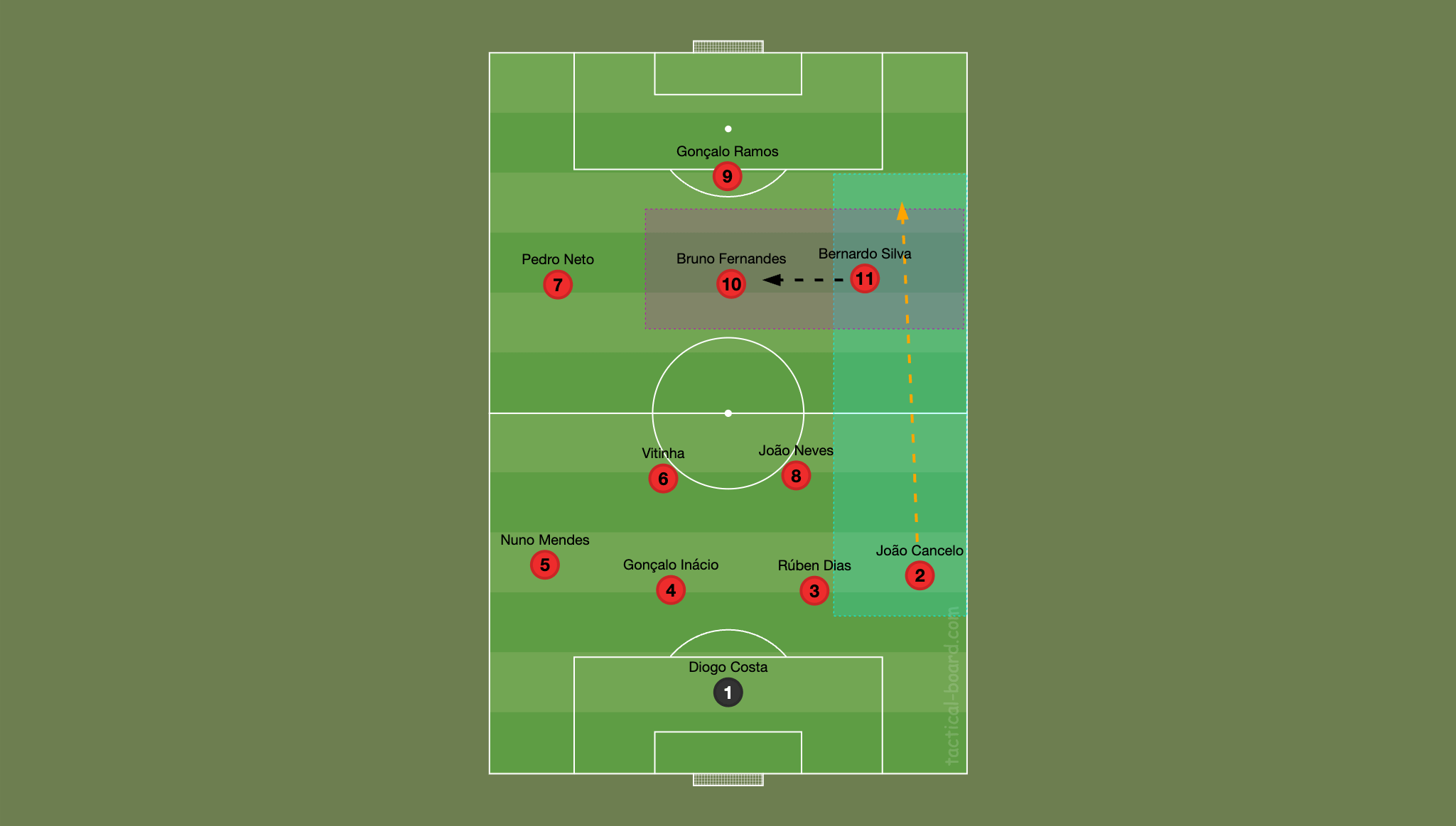
As Bernardo Silva drifts inward from the right flank, Portugal temporarily transform into a four-man midfield square alongside Bruno Fernandes, Vitinha, and João Neves. This creates heavy central overloads designed to maximise circulation, compress opposition midfield lines, and sustain territorial control through short passing combinations. The consequence of Bernardo’s inward movement, however, is the vacated right touchline. João Cancelo responds by aggressively advancing into the wide channel, stretching the opposition horizontally and creating final-third penetration from deeper origins. The result is a structure that balances central control with external destabilisation.
Solution 2
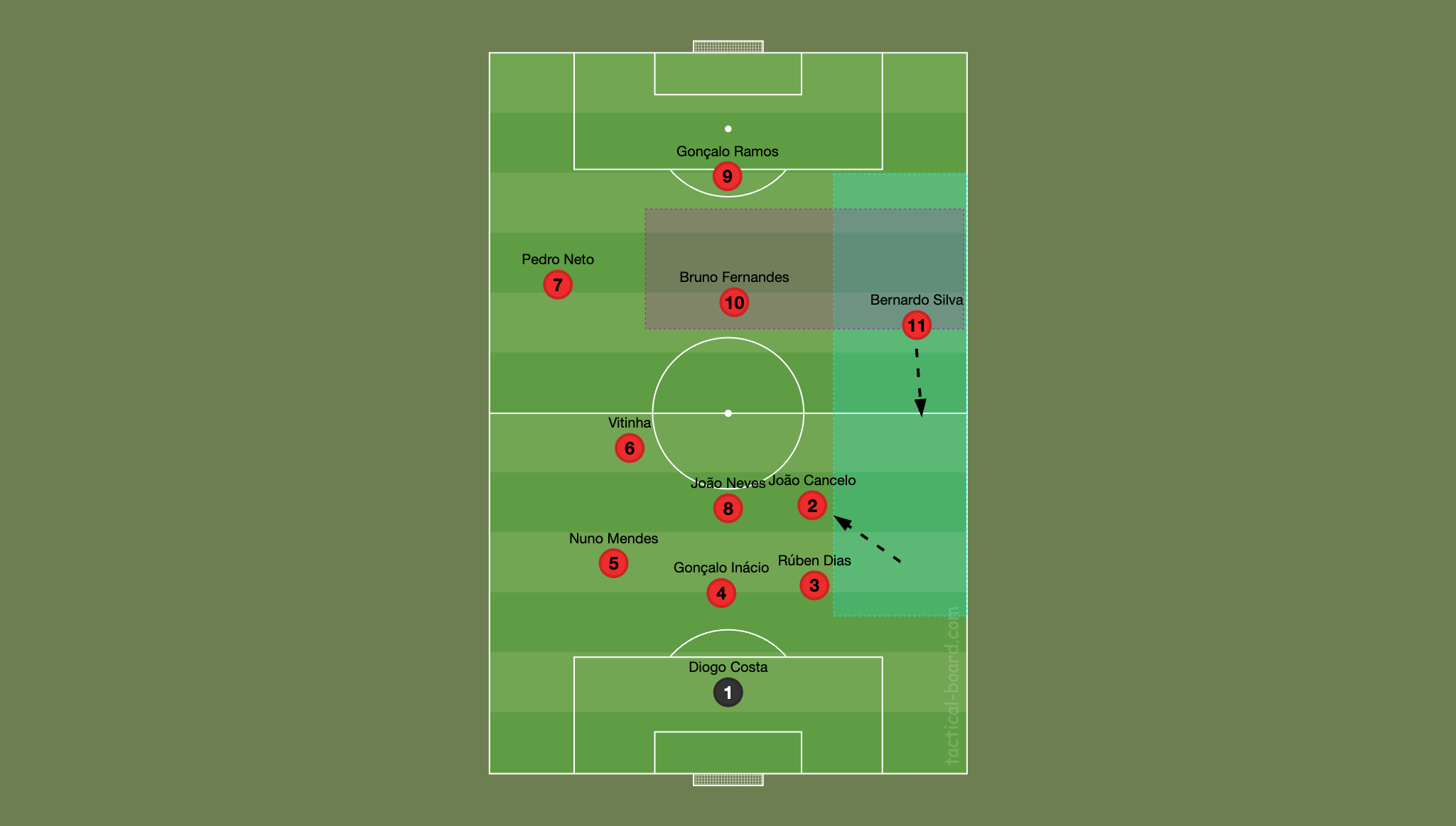
Portugal’s right side can also morph into a more fluid circulation structure depending on the opposition press. Rather than permanently joining Bruno Fernandes centrally, Bernardo Silva may drop deeper into buildup phases to assist progression and reinforce press resistance. In these moments, the shape temporarily resembles a 3-3 structure, with Cancelo partially inverting underneath while Bernardo becomes an additional connective outlet between midfield and attack. This rotation improves passing access under pressure while simultaneously opening diagonal play-switch opportunities into isolated spaces on the weak side.
The Midfield Box
Portugal’s rotating midfield box is not designed purely for possession, but for protection. Through the coordinated movements of Vitinha, João Neves, Bruno Fernandes, and Bernardo Silva, the structure attempts to compress distances centrally and sustain immediate counterpressure after possession loss. Rather than relying on physical dominance alone, the midfield functions through anticipation, circulation, and collective compactness.
Within the structure, Vitinha and João Neves continuously rotate underneath pressure to maintain passing access while protecting transitional spaces behind the ball. Bruno Fernandes and Bernardo Silva operate higher between the lines, balancing vertical progression with circulation support depending on the phase of possession. The objective is to keep Portugal territorially compact enough that defensive transitions can be attacked immediately after the ball is lost.
That responsibility also extends to Gonçalo Ramos. Beyond his role as a penalty-box reference point, Ramos becomes the system’s first defensive layer, aggressively pressing centre-backs, disrupting buildup patterns, and preventing opponents from escaping pressure centrally. His work rate allows Portugal’s midfield box to remain higher up the pitch, sustaining territorial pressure without immediately collapsing deeper defensively.
Collectively, the structure attempts to solve Portugal’s physical limitations through coordinated movement and positional density rather than brute force alone. The box does not seek to overpower opponents athletically. It seeks to suffocate them before transitions can fully emerge.
The Front Five and the Striker Decision
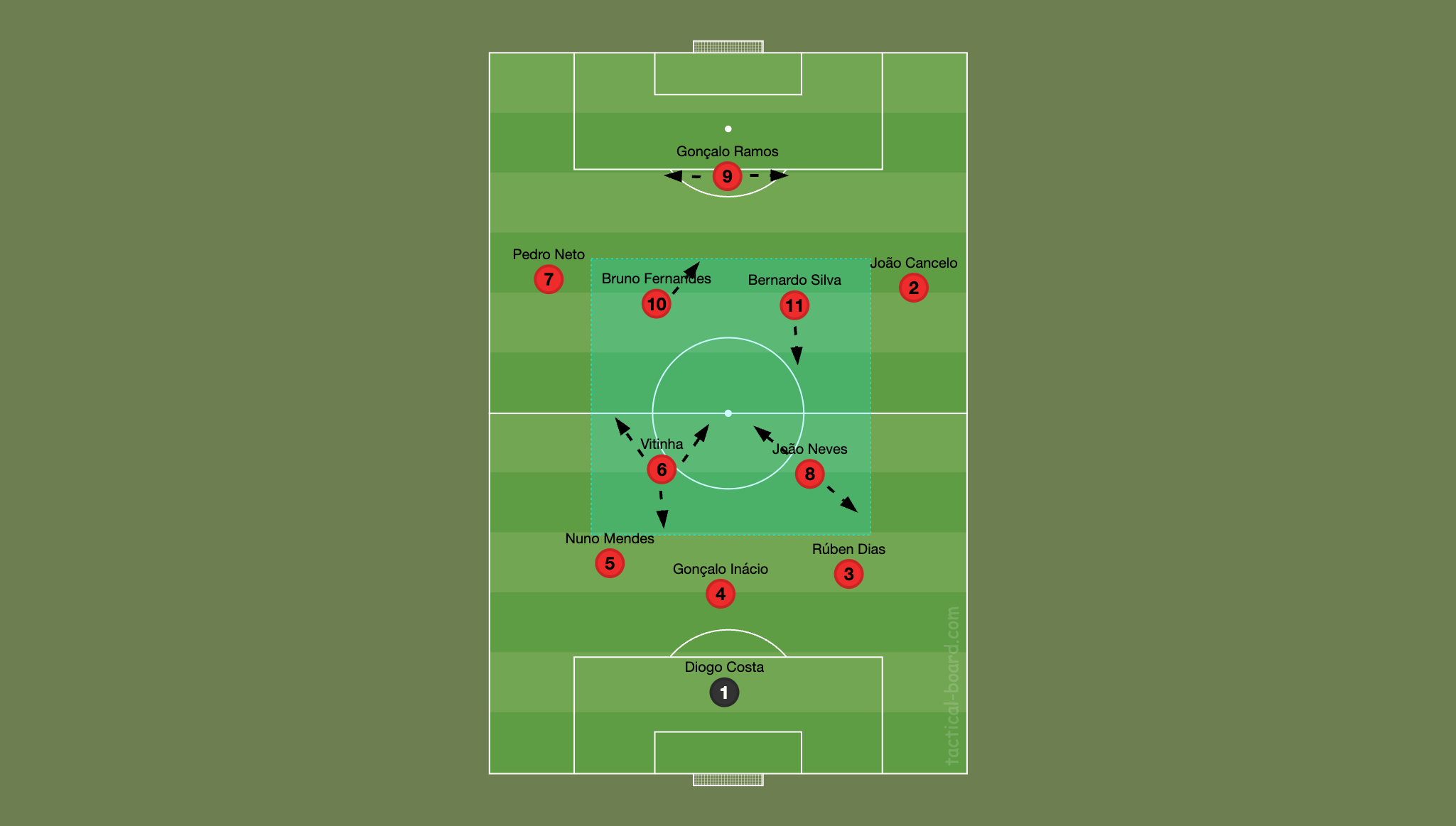
Portugal’s attacking structure ultimately evolves into a rotating front five designed to sustain territorial pressure without sacrificing transitional protection behind the ball. Depending on the side of progression, the shape can emerge either as a 2-3 or a 3-2 structure in the final third, with the surrounding rotations determining where width, penetration, and overloads are generated.
In the more standard 2-3 interpretation, João Cancelo aggressively occupies the right channel while Pedro Neto attacks diagonally from the opposite side. Bruno Fernandes operates underneath the front line as the primary vertical connector, balancing circulation with final-third penetration. Behind them, Vitinha and João Neves maintain the compactness of the structure, ensuring Portugal remain close enough together to sustain immediate counterpressure after possession loss.
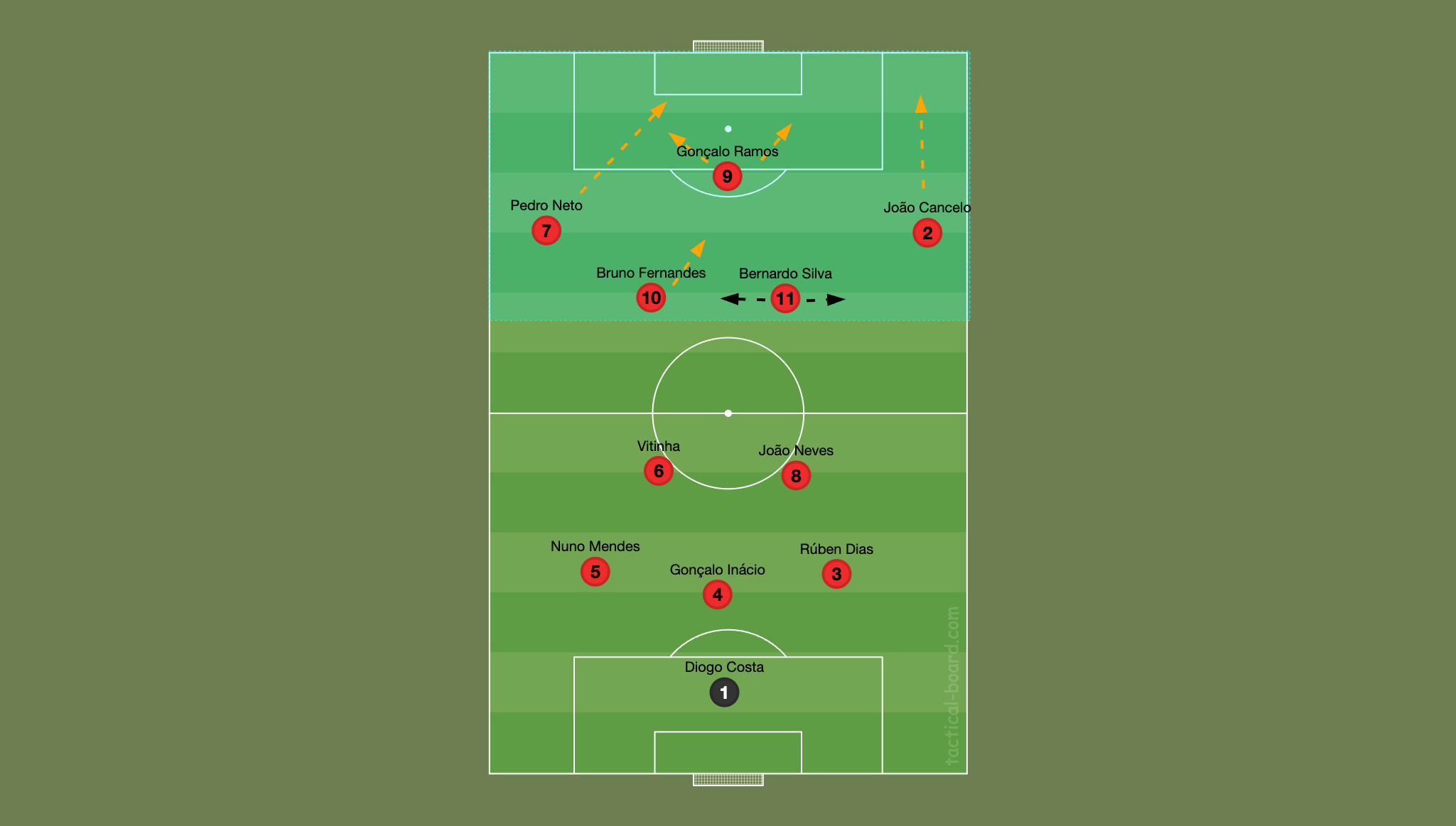
The asymmetry of the system becomes especially important here. Bernardo Silva rarely fully commits himself to the final line despite technically operating as part of the attacking unit. Instead, he occupies safer connective zones between midfield and attack, acting as the structural stabiliser that prevents the distance between Portugal’s pivots and attacking line from stretching too aggressively during offensive phases. His positioning becomes essential in limiting counterattacking exposure while still preserving circulation superiority around the ball.
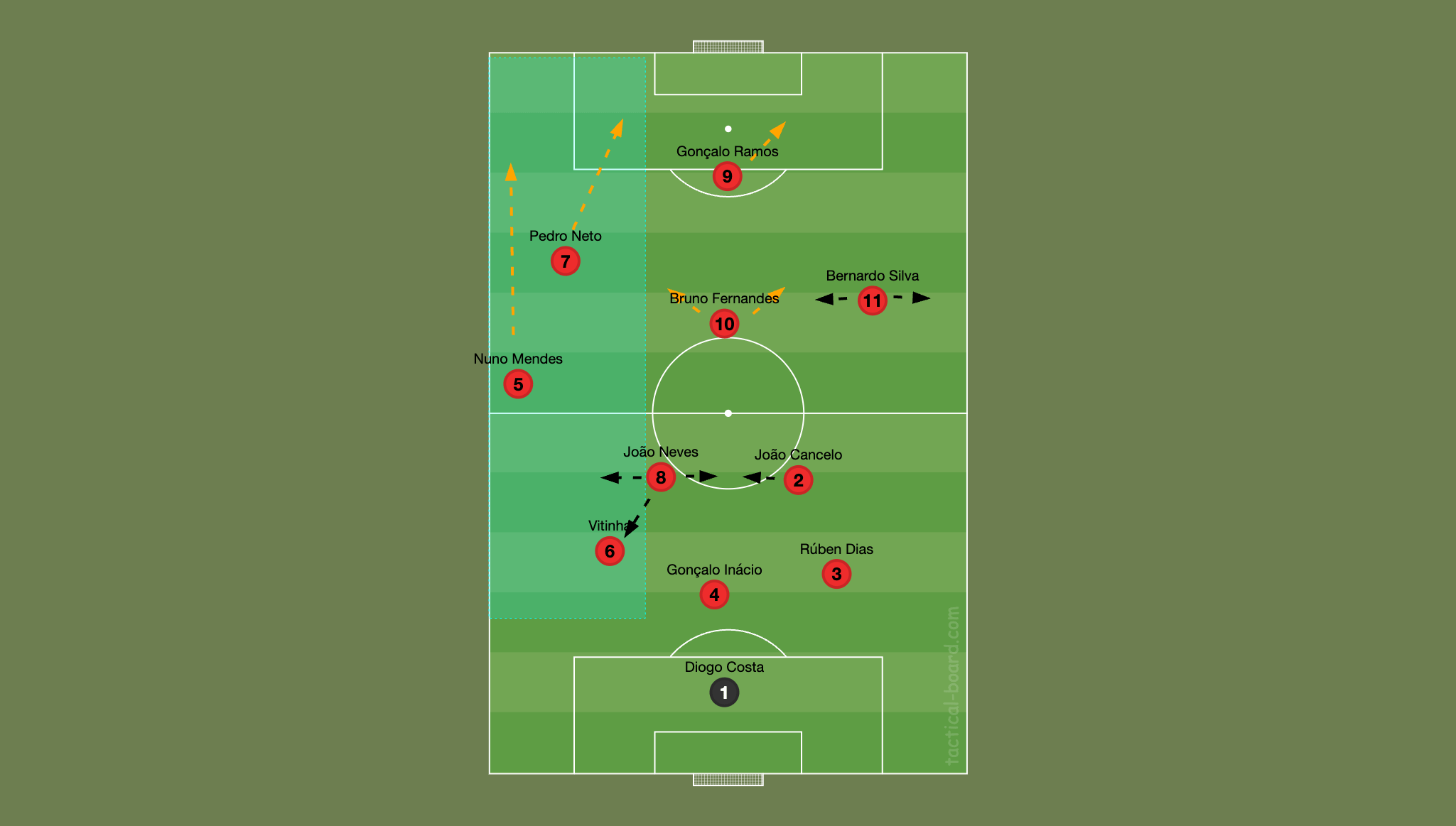
When Portugal switch play towards the left side, the structure can morph further. Nuno Mendes becomes the primary release valve, aggressively advancing higher into wide spaces while the remaining base rotates underneath to preserve balance. In these moments, Portugal temporarily resemble a 3-2 attacking structure rather than the default 2-3 shape, with Mendes’s athleticism and technical quality allowing him to become both width provider and penetrative runner simultaneously.
At the centre of all of this lies the striker decision itself.
Against weaker or more pragmatic opposition, particularly during the group stage, Cristiano Ronaldo’s penalty-box gravity remains enormously valuable. Lower defensive blocks naturally concede greater crossing volume and sustained final-third pressure, conditions where Ronaldo’s movement and finishing instincts can still decisively punish opponents inside the box.
Yet the latter stages of tournament football present a different tactical reality entirely.
As knockout football progresses, midfield spaces compress, defensive transitions become more violent, and attacking units are increasingly required to contribute collectively to territorial protection. In those moments, Gonçalo Ramos’s role becomes structurally vital. Beyond simply occupying centre-backs, Ramos functions as Portugal’s first defensive layer, aggressively pressing buildup phases, protecting the midfield box from the front, and ensuring the attacking structure remains synchronised with the rest of the team behind it.
The dilemma, therefore, is not simply about goals. It is about collective survivability.
Portugal are attempting to construct a system capable of suffocating elite opposition through compactness, circulation, and coordinated movement. Against the strongest sides in the tournament, the question becomes whether the structure can maintain those qualities if the front line no longer contributes aggressively enough to the defensive and transitional phases of the game.
In many ways, the striker decision ultimately reflects Portugal’s wider tournament contradiction itself: balancing the gravitational legacy of the previous era against the systemic demands of the next one.
Best-Case XI
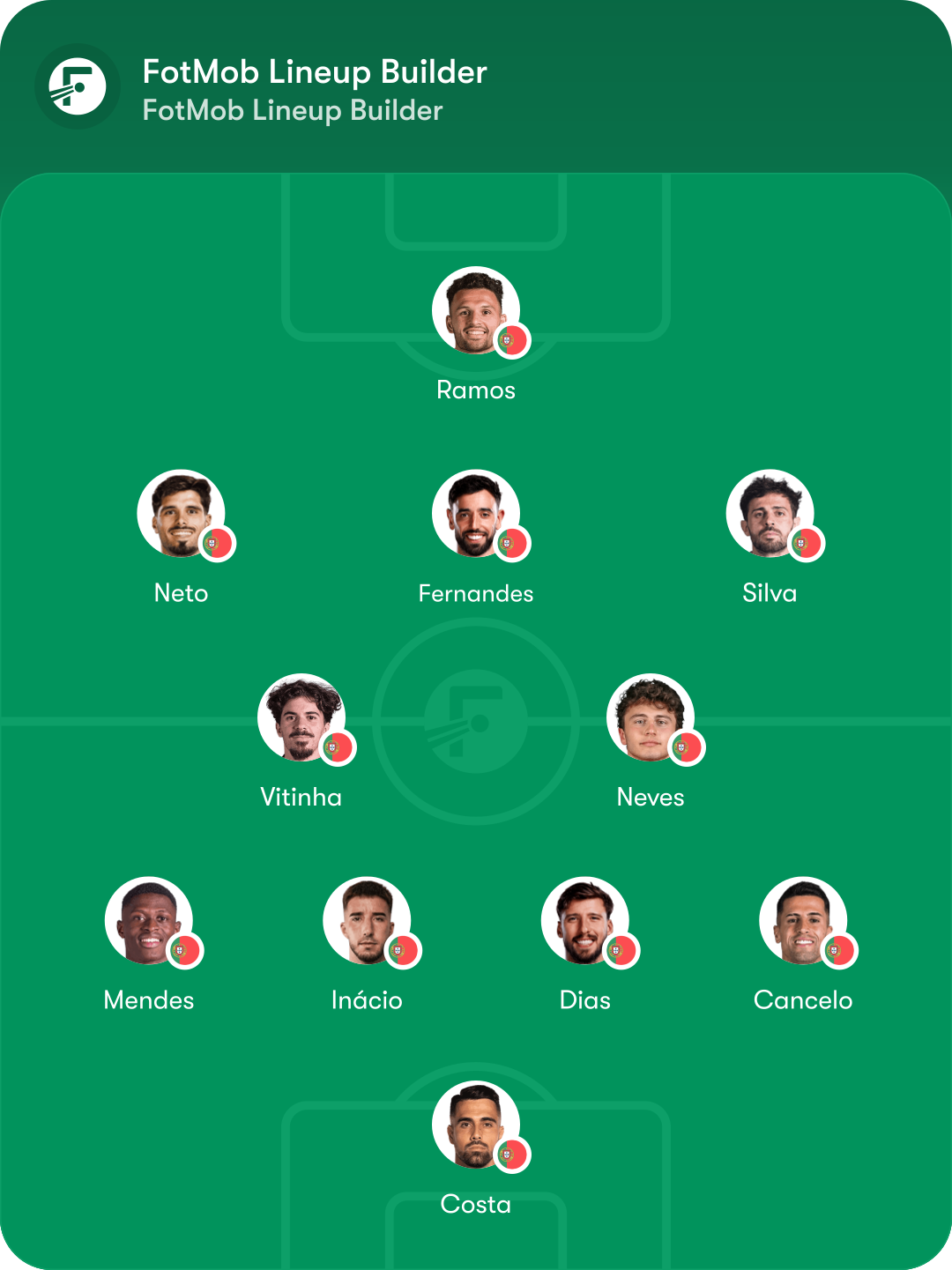
Within the constraints of the announced squad, Portugal’s strongest tournament structure may ultimately emerge through asymmetry rather than positional rigidity. The objective is not simply to field the most individually talented players, but to construct a collective system capable of sustaining territorial pressure while minimising transitional exposure against elite opposition.
The proposed structure prioritises technical permanence, rotational compactness, and coordinated counterpressure over pure physical domination. João Cancelo’s dynamic right-sided movements, Bernardo Silva’s connective positioning, and the Vitinha–João Neves pivot collectively form the circulatory engine of the system, while Nuno Mendes provides the explosive transitional release capable of destabilising defensive structures from deeper origins.
Most importantly, the inclusion of Gonçalo Ramos reflects the system’s wider priorities. Beyond goalscoring alone, Portugal’s striker must help preserve compactness between midfield and attack, ensuring the collective structure remains synchronised during the increasingly chaotic moments of knockout football.
Tournament Outlook
The 2026 World Cup may ultimately represent the defining crossroads of modern Portuguese football. For perhaps the first time in their history, Portugal enter a major tournament not simply with elite individual talent, but with a system sophisticated enough to compete structurally with the strongest sides in world football. Yet their trajectory through the tournament will likely depend on whether that structure can survive the radically different demands between the group stage and the knockout rounds.
The group stage presents two contrasting realities.
Against more pragmatic opponents such as Uzbekistan and DR Congo, Portugal are likely to face prolonged periods of territorial dominance against deep defensive blocks. In those matches, the dynamics of the “Ronaldo Contradiction” temporarily shift. Sustained possession, high crossing volume, and repeated final-third pressure naturally amplify Cristiano Ronaldo’s greatest remaining strengths: penalty-box movement, aerial gravity, and ruthless chance conversion inside crowded areas. Against opponents defending primarily for survival, Portugal may generate enough attacking volume for Ronaldo’s static presence to remain not merely functional, but devastating.
Colombia, however, represent the more revealing tactical examination.
With their physical intensity, transitional aggression, and willingness to attack rather than merely contain, Colombia possess the qualities capable of directly testing Portugal’s structural compactness. Matches of this nature will demand Portugal fully embrace their philosophy of possession permanence: slowing the game through circulation, compressing the pitch territorially, and denying transitional chaos before it can emerge. If the distances between midfield, attack, and defensive support begin stretching too aggressively, Colombia possess the athleticism and verticality to punish those moments immediately.
Yet the deeper questions emerge beyond the group stage.
As tournament football progresses into the knockout rounds, margins collapse into increasingly smaller details. Midfield spaces tighten, defensive transitions accelerate, and collective compactness becomes more valuable than isolated brilliance alone. Against elite opposition such as France, Argentina, or Spain, every disconnected press, every stretched transition, and every unsupported circulation phase becomes magnified.
That is where Portugal’s systemic ceiling will ultimately be tested.
If the structure loses its synchronisation under pressure, or if emotional and symbolic gravity begin overriding the collective demands of the system itself, Portugal risk becoming vulnerable against more physically aggressive and transition-oriented sides. Their technical superiority alone may no longer be enough to sustain control once knockout football descends fully into psychological and physical chaos.
But if Portugal successfully commit to the structural logic underpinning this generation, their ceiling becomes extraordinary.
With Vitinha, João Neves, Bernardo Silva, Bruno Fernandes, João Cancelo, and Nuno Mendes operating within a coordinated and compact framework, Portugal possess the technical intelligence to circulate through pressure, sustain territorial dominance, and psychologically exhaust almost any opponent in world football. For perhaps the first time in their modern history, Portugal no longer require a singular saviour to carry them through a tournament.
The challenge now is whether they are fully prepared to trust the system they have spent decades building toward.