Spain’s Second Star: The Mechanics of a Complete Team
World Cup 2026: How Spain nullified Argentina, survived their own finishing flaw, and won the World Cup through pressure, variety, and one-touch football.

Intro
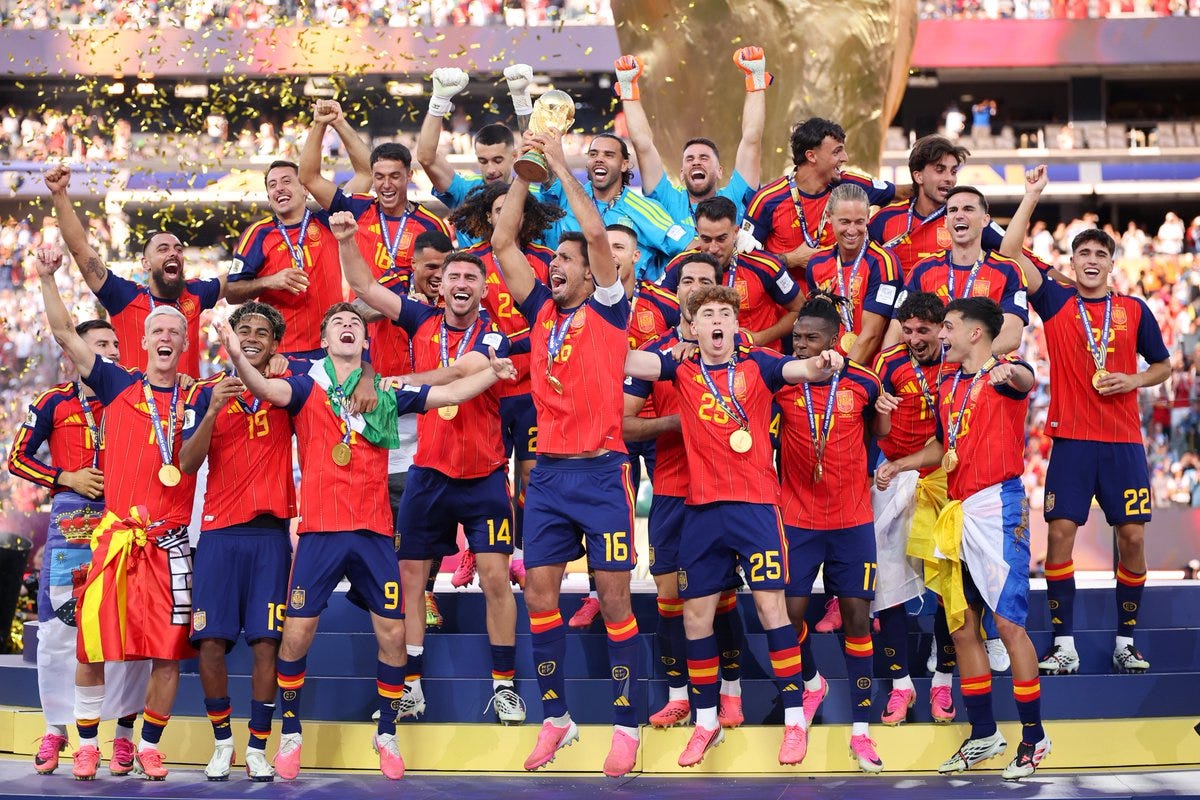
Spain have stopped Argentina’s back-to-back. After following up their European title with a World Cup, they are not only world champions again, but champions in a way where dominance would be an understatement. It was about the control of the tournament, the control of the final, and the way they grew from the group stage into a side that made the competition theirs.
The final itself reflected the superiority of Spain’s system when everything clicked. The right composition, the right technical profiles, the right pressing distances, and the right attacking instincts all came together against an Argentina side that had survived every difficult game before this. Spain removed the conditions Argentina usually need to turn a match back towards themselves.
With this World Cup win, this Spain side has earned its comparison to the golden generation of 2008 to 2012, especially the 2010 team that won the first star. The connection is technical more than nostalgic: control, patience, pressure, and one decisive late action after the opponent had spent too long defending Spain’s rhythm. This review is about that comparison, but mainly about the mechanisms of the final: how Spain nullified Argentina, where their finishing still left tension, and how their attacking variety and one-touch football finally produced the second star.
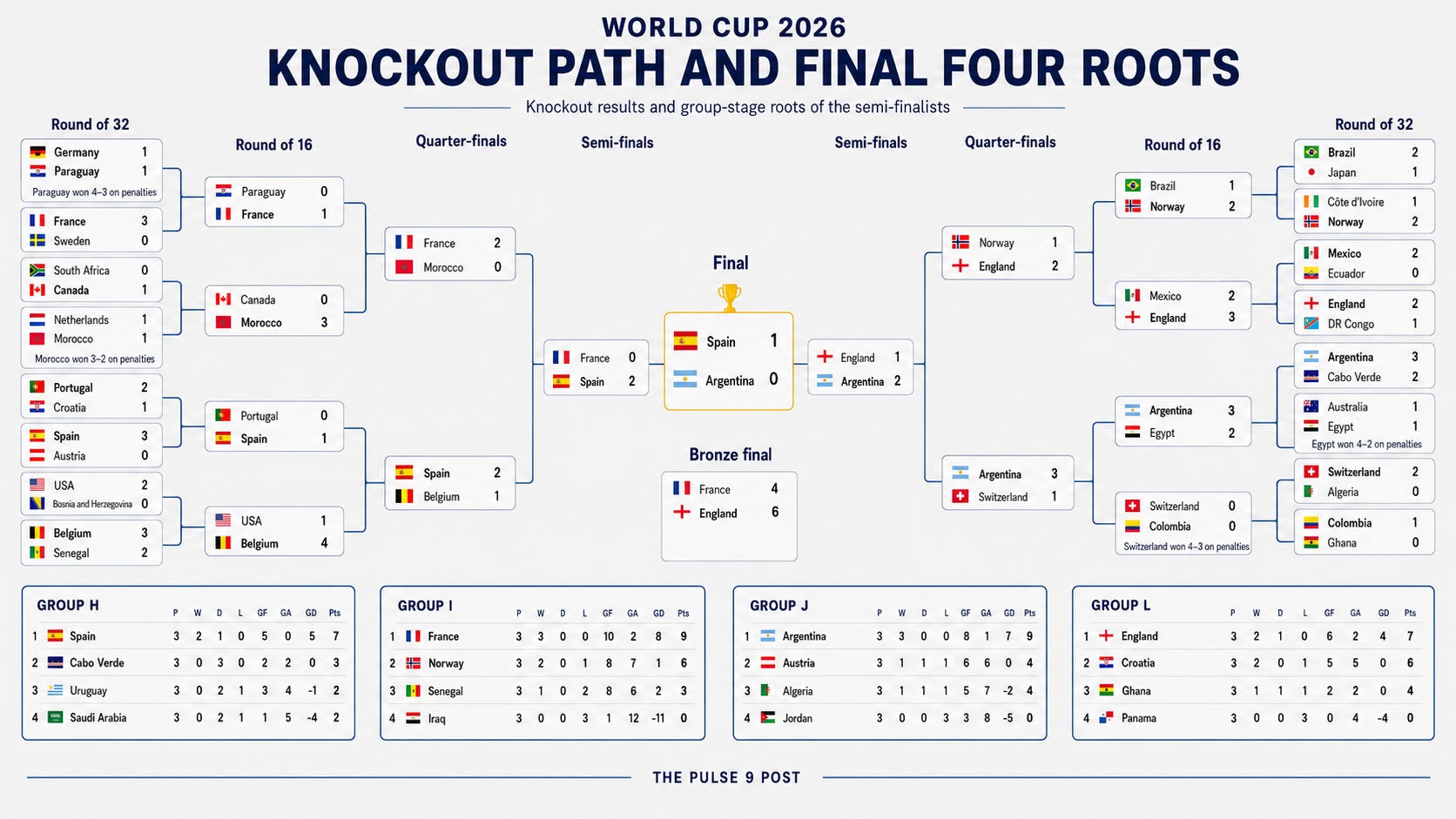
Table of Contents
The Final Match
The Final Mechanism: Nullifying Argentina
Scaloni’s starting idea was understandable. Argentina kept the broad shape from the semi-final by dropping one midfielder for a winger, but this time the width came through Nico González on the left rather than Giuliano Simeone on the right. The logic was to give Argentina a direct runner into the spaces Spain can leave outside their midfield shell. The alternative was a four-midfielder structure, which might have helped them contest Rodri, Fabián Ruiz and Dani Olmo more directly, but would also have made the wide channels thinner. Argentina had carried that problem through the knockouts, so Scaloni chose width first.
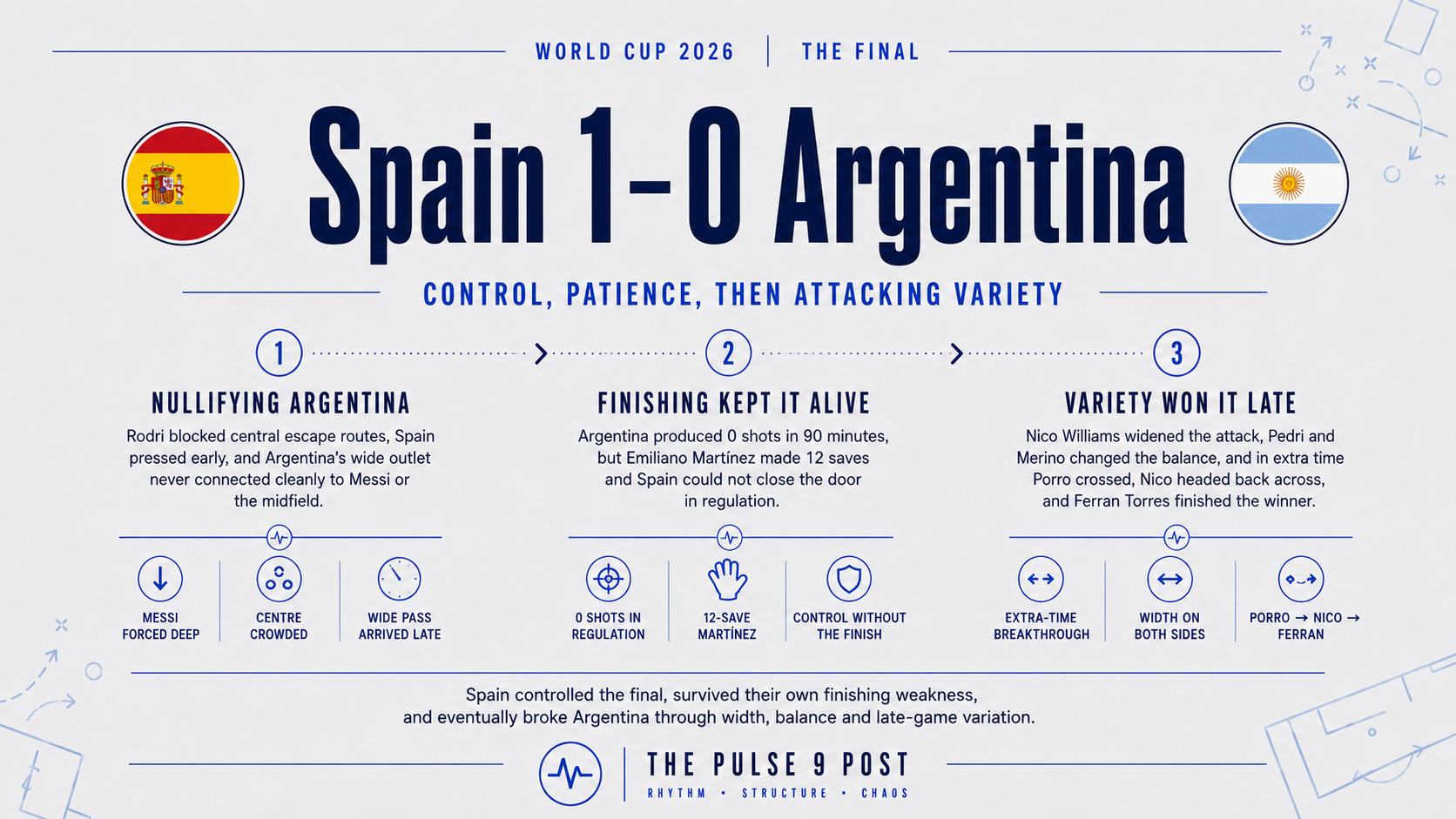
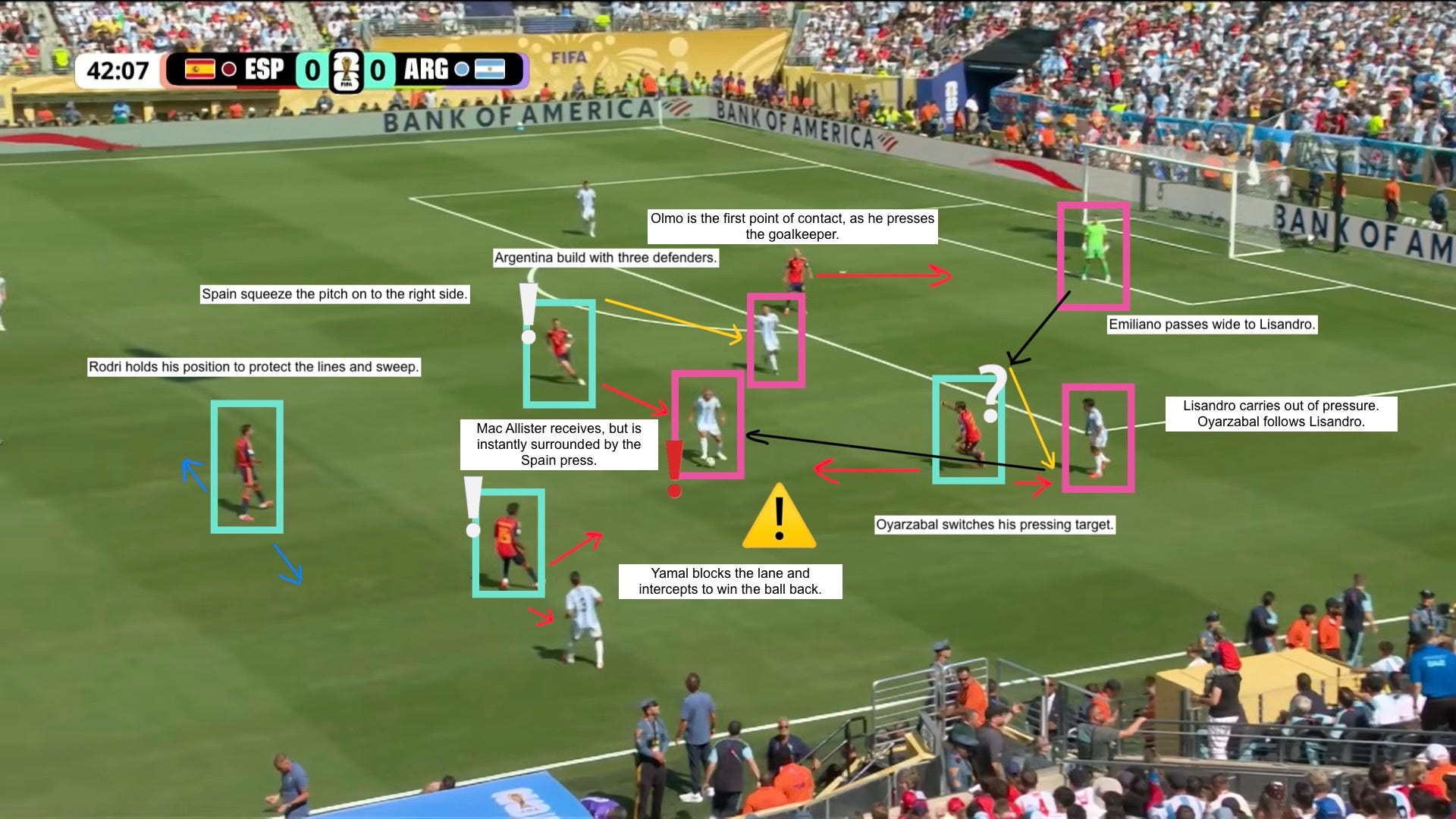
Spain made that choice difficult from the opening minutes. De la Fuente kept the same structure that had worked against Belgium and France, and the game quickly became a test of whether Argentina could connect their wide idea to the rest of the team. They rarely did. Spain pressed early, compressed the pitch, and crowded the zones where Messi and the midfield would usually receive before turning the next action into danger. Crucial to this was Rodri’s rest-defense positioning: by anchoring in front of Spain’s high block, he consistently cut off central escape valves, forcing Messi to drop deep into unproductive pockets just to touch the ball. Argentina’s direct balls did not find enough support, the midfield struggled to see enough of the ball, and the winger gave Argentina a theoretical outlet, but the pass into that outlet kept arriving late, rushed, or without the next connection around it.
The final was shaped by Spain’s tempo control more than by constant speed. Their best spells came in chunks. In the quieter phases, they circulated, protected their structure, and made Argentina defend without giving them many transition windows. Around the later parts of each half and after the hydration breaks, Spain lifted the pace, attacked the wide zones earlier, and started finding more threatening entries. That rhythm kept Argentina stuck between two uncomfortable jobs: defending the centre against Spain’s extra-man structures, then recovering wide when Porro, Yamal, Cucurella or the left-sided winger stretched the pitch.
Scaloni’s substitutions gradually became survival moves. Paredes for Nico González added another midfielder after half-time, but it did not give Argentina control of the ball. It helped crowd the centre, while weakening the same wide escape route Argentina had selected from the start. Giuliano Simeone later restored running threat, yet the larger issue remained the connection between units. Without enough speed behind the Spanish line, the long balls were not landing. Without enough midfield rhythm, Messi could not pull the game towards himself. Without the starting centre-backs, Argentina’s back line also lost continuity at the exact moment Spain’s bench began to change the final.
De la Fuente’s changes worked in the opposite direction. Ferran Torres for Oyarzabal kept the striker role functional, but added alternative penalty-area instincts. Pedri for Fabián Ruiz gave Spain more calm once the game was being played a little beyond its ideal speed. Fabián had offered quick decisions, running and one-touch forward actions; Pedri brought central authority, steadier pauses and more control over the next pass. Merino for Olmo then restored some of the lost arrival threat, but with more late-game power and box presence. Spain were changing the game’s structural balance without losing the structure itself.
Nico Williams was the decisive shift. Once he entered, Spain’s width became fully weaponised. Cucurella and Nico on one side, Yamal and Porro on the other, with Pedri, Rodri and Merino holding the centre, gave Spain threat across every lane. Argentina could no longer overprotect one side without exposing the other. The red card to Enzo Fernández only deepened that mismatch. What had already been a difficult defensive assignment became a prolonged phase of retreat, with Spain able to keep attacks alive, recycle pressure, and load the box without losing rest defence.
The Finishing Weakness That Kept the Final Alive
Spain created enough to win the final far earlier than they did. The disparity was staggering. Argentina were held to zero shots across 90 minutes of regulation time, with no shots on target at all, and entirely starved of goal threat. Yet Spain couldn’t close the door, largely because Emiliano Martínez produced a heroic 12-save performance to deny shots from the half-spaces, low cutbacks, and late box entries. Spain were entering the right zones effortlessly, but the final action continually fell short of the net.
That dynamic kept the match alive. Spain were superior in territory, tempo, and structure, but their finishing weakness meant Argentina never had to fully abandon belief. Every missed chance and Martínez save gave Argentina another few minutes to survive the pressure, slow the match, and wait for one broken phase to appear. For a side that had spent the knockouts turning late moments into results, that was the one danger Spain allowed to remain.
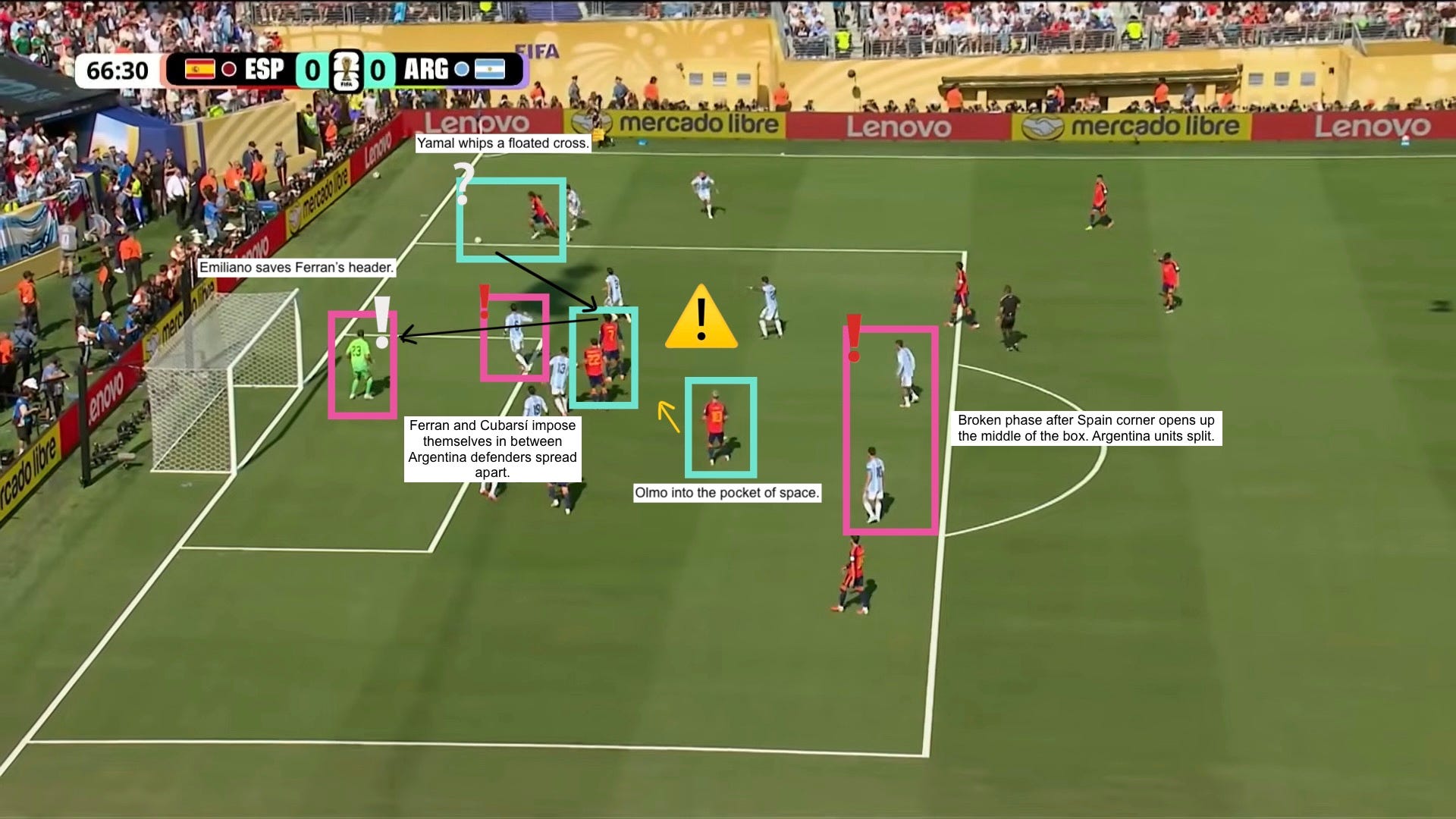
The limitation was visible across different players, which made it feel structural rather than individual. Spain do not have one ruthless forward who guarantees the final action. Their attacking strength comes from variety, movement and shared responsibility, but the trade-off is that some chances arrive to players who are contributors rather than killers. That does not make the system weak, but it explains why a match they controlled still needed extra time.
De la Fuente’s forward changes made sense in that context. Oyarzabal had helped the build-up, dropped into useful zones, and supported Spain’s attacking structure, but the final needed sharper penalty-area instinct. Ferran Torres gave Spain a different edge. The same finishing issue carried into extra time for a while, yet the variety of Spain’s attack eventually produced the clearest chance of the match.
Spain’s finishing weakness kept the final tense, but their attacking variety kept giving them new ways to ask the question.
Attacking Variety and the Winning Goal
As the final moved deeper, Spain began adding more pace, height and variation into the attack. The earlier circulation had given them control, but the substitutions gave that control more bite. Nico Williams changed the left side immediately, not only through dribbling, but through the way he roamed into pockets, attacked the far post and made Argentina defend a second dangerous wing rather than simply shifting towards Yamal and Porro. Spain’s attacks stopped looking like forced U-shaped circulation and started arriving through both sides, with runners appearing across different vertical lanes.
Extra time made that shift clear. Nico’s disallowed goal came from increased ball speed, more numbers around the box and quicker anticipation of the second action. Merino’s point-blank header from a Williams cross carried the same warning: Spain were now combining width with height, delivery with late arrival, and ball circulation with penalty-area threat. Argentina had spent most of the final surviving Spain’s control. By extra time, they were dealing with a more complete version of it.
The winning goal in the 106th minute used almost every part of that late-game variety. Porro delivered from the right, Nico arrived at the far post and headed the ball back across goal, and Ferran Torres finished with his left foot. The move was Spain’s composition in one action: right-side delivery, left-side presence, substitute sharpness, one-touch instinct and a striker attacking the space before Argentina could reconnect the line.
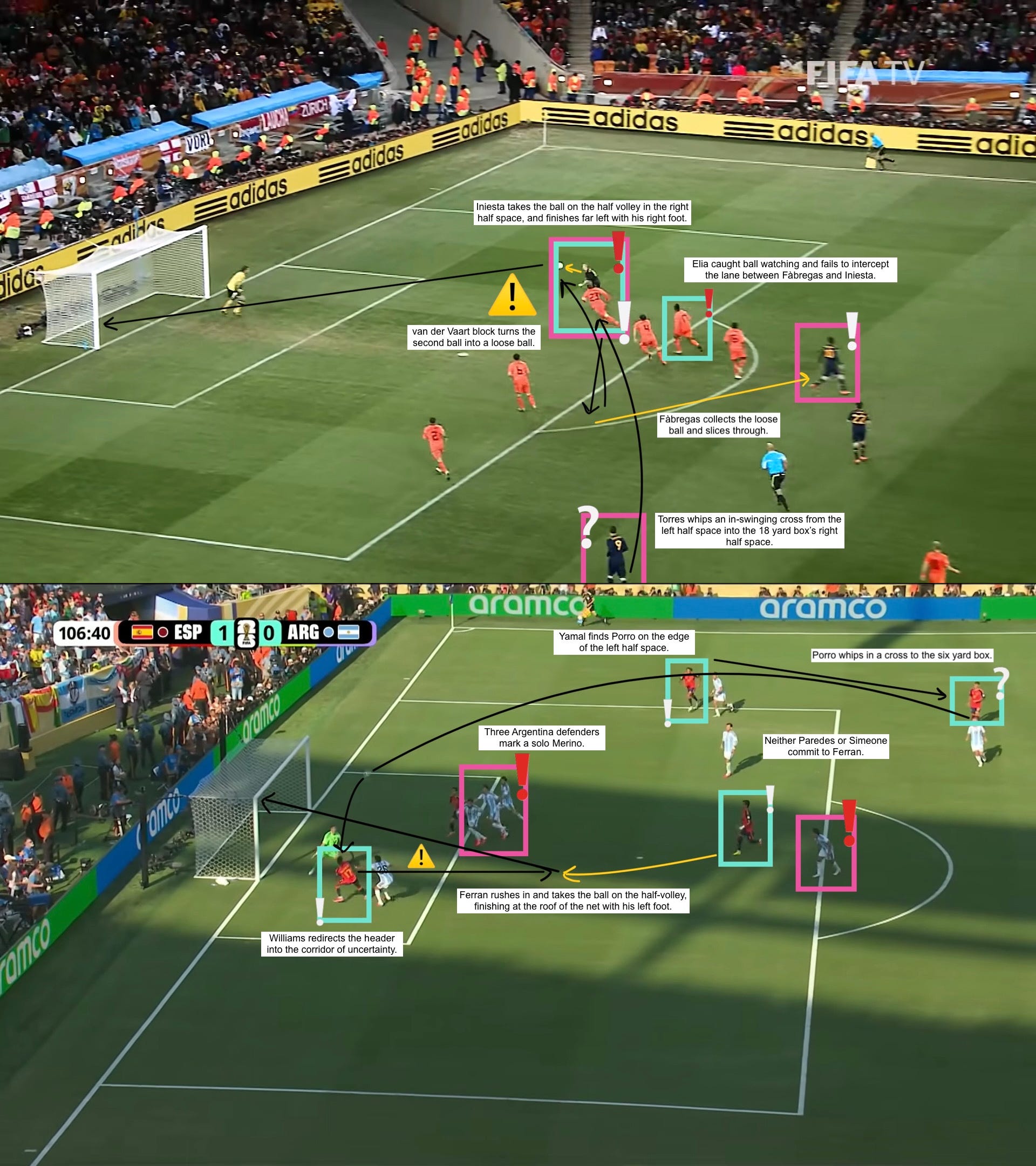
The parallel with Iniesta in 2010 is both a similarity in folklore and technical execution. Iniesta’s goal came four minutes before penalties, after Spain had kept the match alive through patience and pressure. The ball came from a wide action, the first delivery was not fully cleared, Fàbregas found Iniesta on the right side of the box, and Iniesta finished right-footed on the half-volley. Ferran’s goal arrived from the other side of the pitch logic: the right-side cross, the far-post second action from Nico, and the left-footed finish from the left half-space. Different feet, different side, same Spanish ending: stretch the opponent, win the second action, trust the late runner.
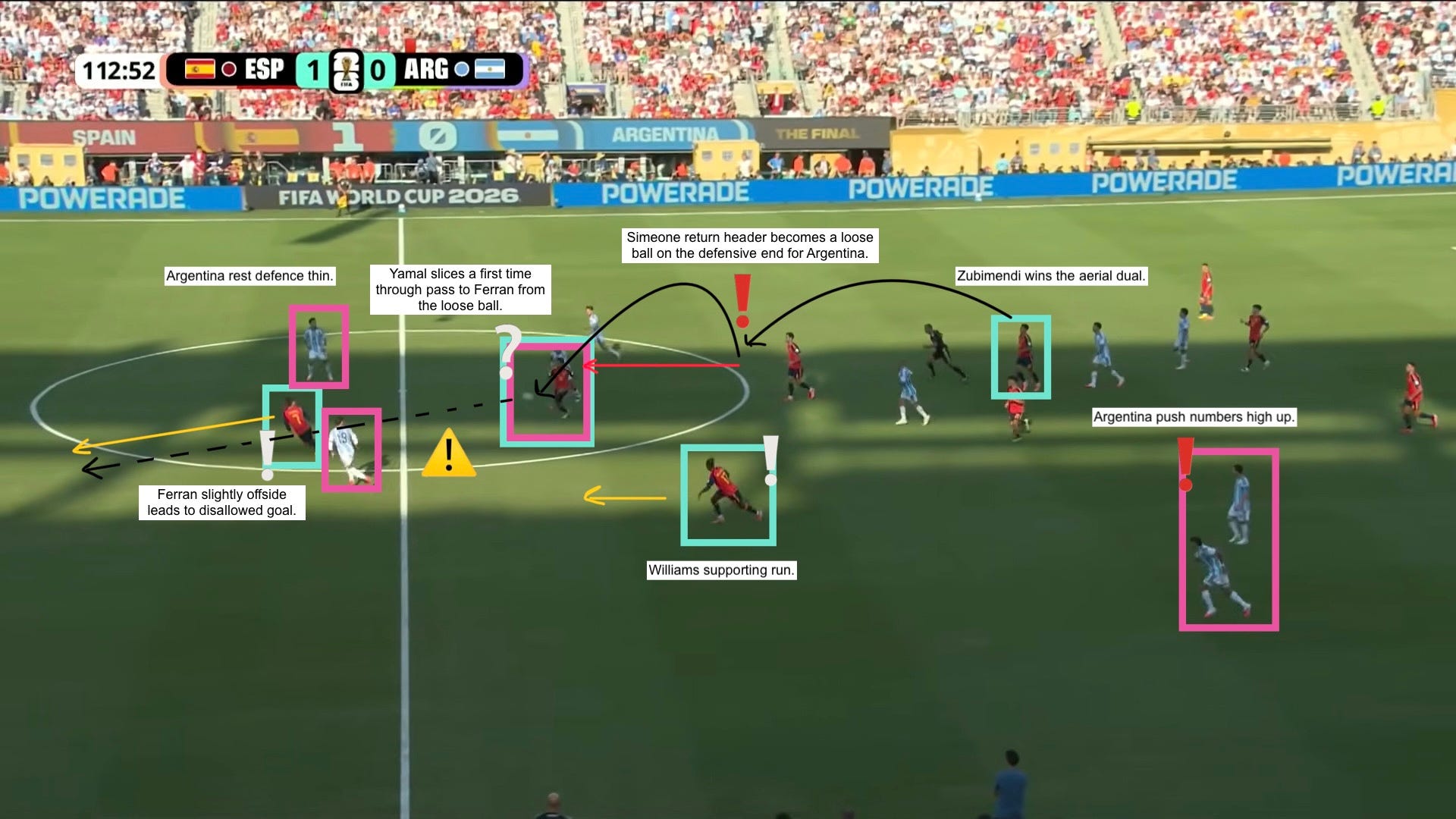
After the goal, Spain looked freer. Argentina pushed forward, but much of their response became direct and hurried. Ferran nearly had a second from Yamal’s one-touch pass before the flag went up, and Spain’s own defending had to stay alert, especially when Cubarsí made the late point-blank intervention. The final had become what Spain wanted by then: calm control turning into siege, siege turning into confidence, and confidence finally producing the second star.
Why This Spain is the Better Football Machine
Spain’s 2026 side has to be considered a dynasty now. A European Championship followed by a World Cup immediately mirrors the 2008 to 2010 run, and with the second star secured, this team has earned the right to be compared with the golden generation. The 2010 side may still win the raw talent argument. Xavi, Iniesta, Busquets, Xabi Alonso, Villa, Casillas, Puyol and Ramos carry a different level of footballing iconography. The more interesting question, though, is whether the 2026 team is the more complete and efficient football machine.
Using FotMob’s numbers, the attacking gap is clear. In 2010, Spain scored eight goals across seven games from 8.90 xG, around 1.14 goals and 1.27 xG per game. In 2026, Spain scored 14 goals from 15.63 xG across eight games, rising to 1.75 goals and 1.95 xG per game. Even after accounting for the extra match in the expanded format, this Spain created more per game, with mixed volume and quality.
The goal spread sharpens the point. In 2010, David Villa scored five of Spain’s eight goals, a staggering 62.5 per cent of the total. The only other scorers were Andrés Iniesta and Carles Puyol. In 2026, Mikel Oyarzabal also finished with five, but that was only 35.7 per cent of Spain’s 14 goals. The rest came through Mikel Merino, Pedro Porro, Ferran Torres, Lamine Yamal, Fabián Ruiz, Álex Baena and an own goal. The 2010 attack leaned heavily on Villa to provide the vertical edge while the midfield recycled possession. The 2026 attack spread the burden through the whole structure.
The passing numbers point in the same direction. Spain completed 3,796 passes in 2010, which works out to roughly 474.5 completed passes per goal. In 2026, they completed 4,780 passes, but because the goals arrived more often, that dropped to 341.4 completed passes per goal. Per match, the 2026 side actually completed more passes as well, around 597.5 compared with 542.3 in 2010, while also improving the completion rate from 86.9 per cent to 89.5 per cent. They passed more, passed better, and turned those passes into goals more efficiently.
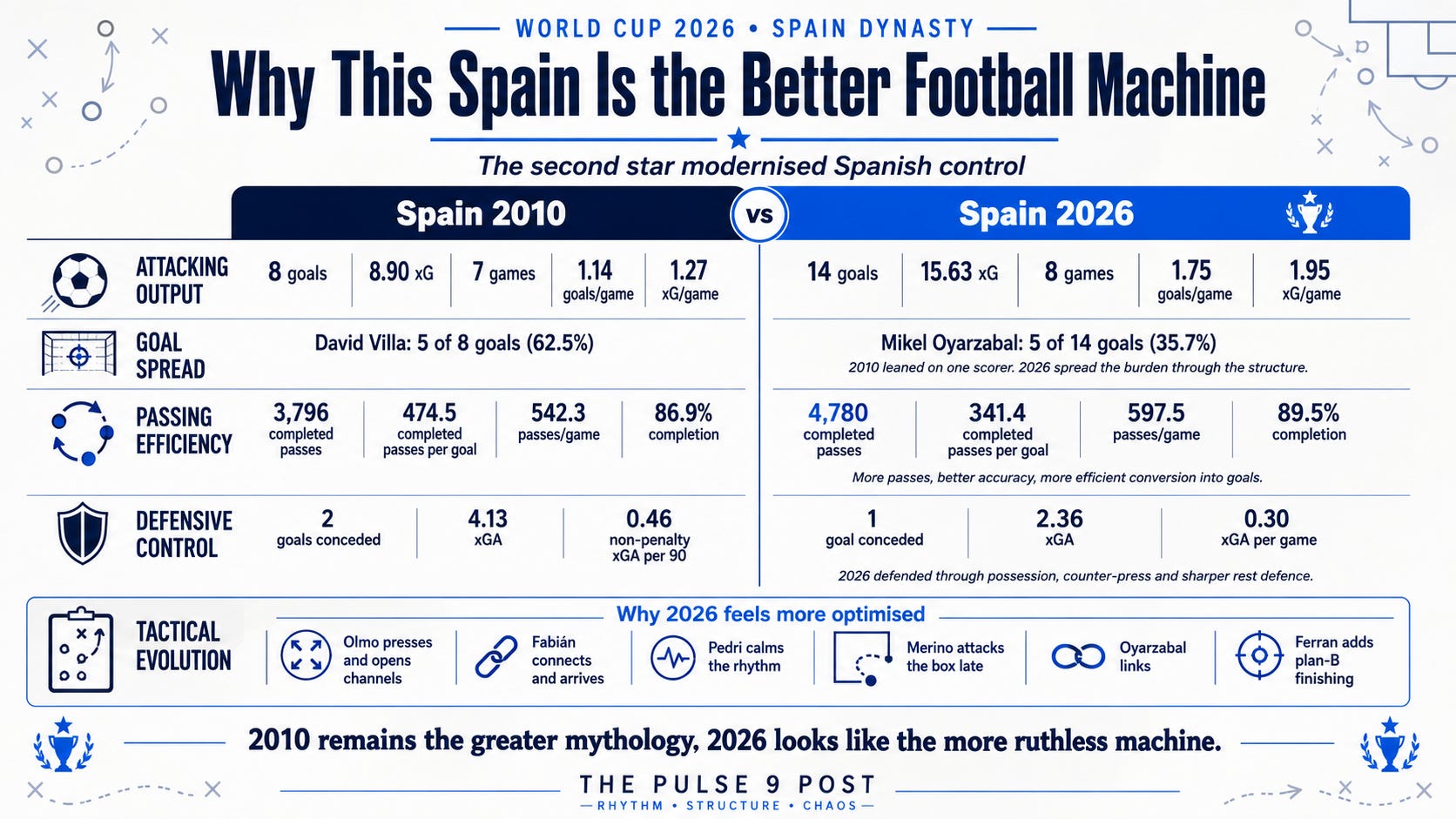
That shows the shift from possession defence to pressing defence. The 2010 team defended by keeping the ball and shrinking the match. The 2026 team did that too, but with a stronger counter-press and sharper rest defence behind it. They denied opponents possession and also stopped attacks before they could become final actions. The ball rarely reached the most dangerous areas smoothly, which is why the one-goal-against record reflects more than goalkeeper form or finishing luck.
Defensively, the gap becomes even more striking. In 2010, Spain allowed around 0.46 non-penalty xG against per 90. Once the Paraguay penalty is added back into the total, and their nominal minutes played is accounted for, that gives roughly 4.13 xGA across the tournament. Conceding only twice was still elite, but the chance profile included real danger moments, especially Robben’s break in the final and Paraguay’s penalty. In 2026, Spain conceded only once across eight matches, the fewest goals ever allowed by a World Cup-winning team, and the xGA was even more severe: 2.36 across the tournament, around 0.30 per game.
The evolution from the older Spanish cycle also helps explain the difference. From 2008 to 2012, Spain moved from a more natural forward structure with Torres and Villa, to Villa as the main 2010 reference, then into the 2012 false-nine version with Fàbregas. The direction kept moving towards midfield control. De la Fuente’s Spain have been more consistent in their striker framework, first with Morata in 2024 and then Oyarzabal in 2026, but the flexibility came around the striker rather than through abandoning the role entirely.
That flexibility was especially visible in the midfield choices. In 2024, Fabián Ruiz became essential as a deeper midfield piece, while Pedri’s injury opened the door for Dani Olmo to take the 10 role and give Spain more off-ball movement between lines. In 2026, Pedri initially gave Spain more control from deeper areas, but the tournament eventually demanded more running and vertical balance. Fabián returned, especially from the quarter-final onward, because Spain needed quicker connective actions and more arrivals beyond the ball. In the final, the rhythm had to be slowed again, and Pedri’s introduction gave Spain more central authority. Merino then restored the late box-running threat that had been reduced once Fabián came off.
That is why this Spain is more optimised. Olmo can press and open channels. Fabián can connect and arrive. Pedri can calm the rhythm. Merino can attack the box late. Oyarzabal can drop and link, while Ferran can enter as a plan b finisher. The roles can change without the system losing its identity.
The 2010 team remains the greater mythology. It was the first star, the peak of a historical midfield, and the side that defined Spain’s place in world football. The 2026 team looks more ruthless as a machine. It creates more, concedes less, spreads goals better, presses higher, protects transitions more aggressively, and uses the bench to alter rhythm without changing the idea.
While the first star defined Spanish control. The second star modernised it.
Verdict
Spain’s second star closes a long argument about what Spanish football was supposed to become after 2012. The years after the golden generation were not empty, but they were trapped by the shadow of the old model. Spain could still control games, still pass through pressure, still dominate possession, but too often the control became a habit rather than a weapon. The ball moved, the opponent waited, and the final action never arrived with enough force.
That is why this title is bigger than a simple return to the top. Spain did not abandon their footballing culture to escape the dark age after tiki-taka. They allowed it to evolve. The traditionalism had to die, but the tradition itself survived. Control remained, only now it came with pressing, width, runners, one-touch acceleration, full-back aggression and a stronger instinct to attack the box before the opponent could reset.
The old idea of La Furia returns in a modern form. Unlike the old stereotype of chaos, aggression and blood-and-thunder football, it became fury expressed through pressure after loss. Through the timing of the next run, the winger attacking his full-back, the midfielder crashing the box, and the refusal to let the opponent breathe after the first clearance, Spain became Spanish in a way that fits the modern game.
The final against Argentina was the perfect proof. Spain controlled the match, but they also hunted it. They denied Messi the conditions he needed, kept Argentina away from their broken-phase strengths, survived their own finishing weakness, and eventually found the goal through the same principles that carried the whole tournament: width, pressure, second actions, and one-touch instinct.
The 2010 team gave Spain its first star by defining control. The 2026 team gave Spain its second by freeing that control from its own limits. That is why this side can be viewed as the better football machine. The golden generation created the language. This generation made it faster, wider, sharper, and ruthless enough to rule the world again.